
Williamsburgh Savings Bank Tower
The Williamsburgh Savings Bank Tower, the 1929 clock tower at 1 Hanson Place by Halsey, McCormack and Helmer, the firm that also enlarged the landmark Dime Savings Bank from which Michael Stern’s The Brooklyn Tower rises, stands where Atlantic and Flatbush avenues cross.7 It is easiest to read from the top down, because the top is what most people know. Four clock faces, one on each side of the shaft, have given the building its public identity for close to a century. Below them sit a gilded dome, a tall setback shaft, a carved base and a banking hall finished like a church.
The clock
The clock was built at a scale meant to be read across neighborhoods. The Skyscraper Museum’s profile notes that its four sided face was the largest in the world until 1962, when the Allen Bradley clock tower in Milwaukee overtook it.1 The building’s own website describes the clock as visible for miles and as the borough’s unofficial beacon from the start.5
It has not always kept time. The Brooklyn Paper reported in 2007 that the clock had stood still for most of two decades after 1970 until Republic National Bank restored the landmark, and that during the condominium conversion of the 2000s it sat wrapped in black netting, its four faces showing different times, while repairs slipped from one promised date to the next.3
The dome
Above the clock sits a dome its own architect did not want. The Skyscraper Museum says the bank overruled its designers and demanded a gold dome, a reference back to the institution’s first home in Williamsburg.1 That first home was George B. Post’s competition winning bank at 175 Broadway, finished in 1875 and landmarked since 1966, according to the Brooklyn Historical Society’s guide to its Williamsburgh collection.2 The dome on Hanson Place is therefore a quotation, a skyscraper wearing the crown of a Victorian bank.
The shaft
Beneath the dome the tower rises through 34 floors to 512 feet.1 Writers do not agree on what to call its style. The Skyscraper Museum describes an Art Deco building given a neo Moorish flavor by its Spanish detail and copper dome, the tower’s residential website calls it Art Deco inside and out, and the Historic Districts Council’s landmark note calls it Byzantine, with setbacks that step the mass back as it climbs.14 The range of labels reflects a late 1920s design that mixed historical sources freely.
The tower by the numbers
- overall height
- 512 feet
- floors
- 34
- construction
- 1927 to 1929
- ceiling height of the banking hall, lit by windows 40 feet tall
- 63 feet
The base
The lower floors carry the building’s finest stonework. The Historic Districts Council singles out the setback and the fine ornament and rich carving of the lower two stories as the building’s most striking features.4 The facade is limestone, according to that website, which also describes the gilded dome and intricate mosaics as intended to project confidence in the prosperous years before 1929.5
The banking hall
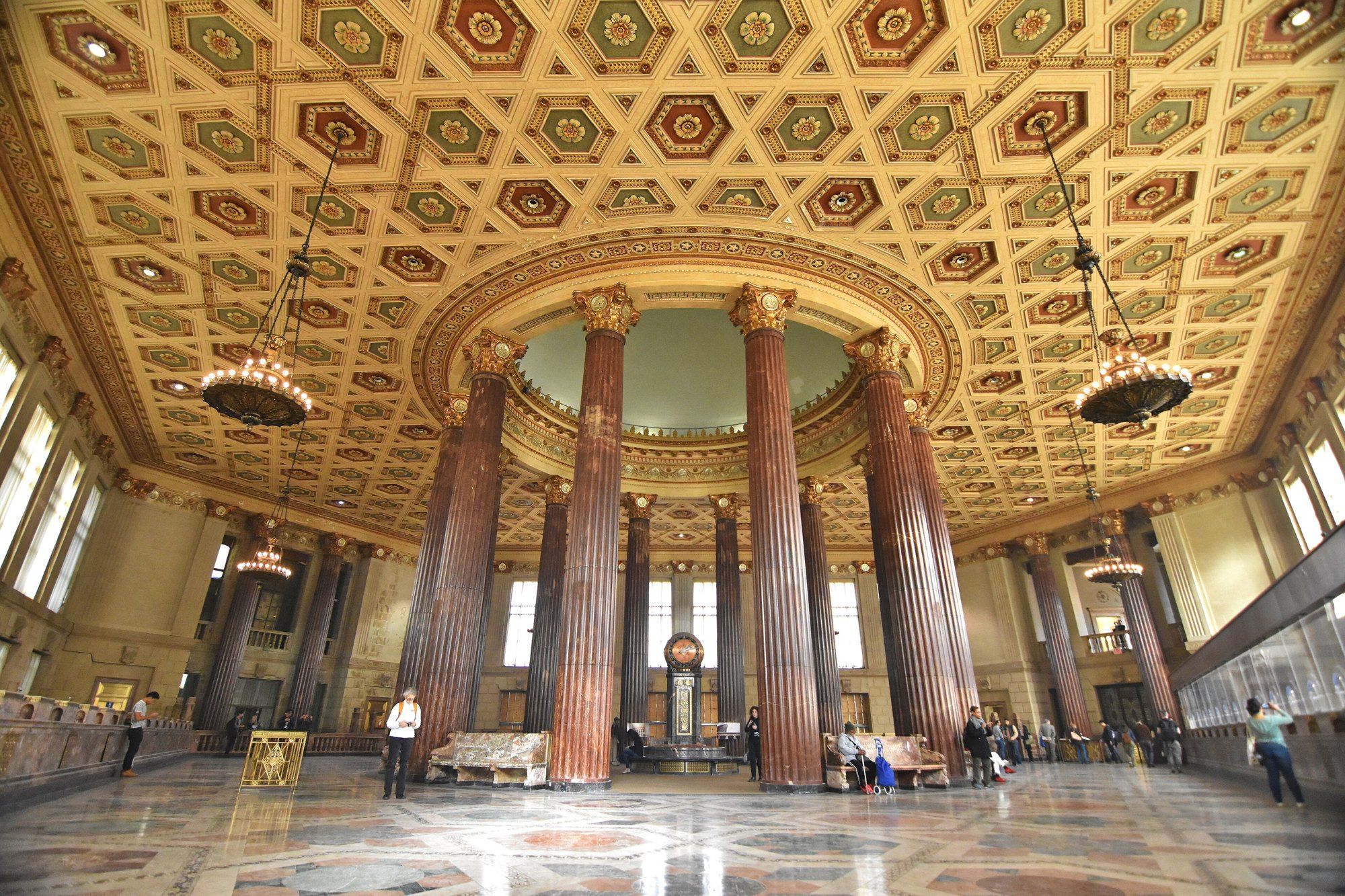
The interior earned its own designation. The Historic Districts Council describes the great banking room as a Romanesque Revival space that treats banking almost as a religious act: a basilica of three bays on a nave and aisles plan, finished in exotic marbles, Cosmati floors, golden mosaic vaults and enamelled steel, with sculpture by Rene P. Chambellan and mosaics by Angelo Magnanti, including a mural of the bank’s place in the life of Brooklyn.4 The Skyscraper Museum supplies the scale: sixty three feet from floor to ceiling, with windows of forty feet.1
A church plan for a bank was deliberate. Bank buildings of that era were meant to awe customers or to calm them about their deposits, and a basilica did both in the gravest architectural terms at hand.7
The builders
The designers were specialists. The Brooklyn Historical Society calls Halsey, McCormack and Helmer bank specialists, whose work also includes the Bronx building that began as the Dollar Savings Bank.2 Lehman College’s note on the Grand Concourse building explains the firm’s hold on such work by George H. McCormack’s years as a banker before he practiced architecture.8 Brownstoner’s profile of their Brevoort Savings Bank lists the Hanson Place tower beside the firm’s expansion of the Dime on DeKalb Avenue as leading Brooklyn examples of its work.7 The Skyscraper Museum lists the general contractor as the William Kennedy Construction Company.1
The height
For eighty years the tower set the upper limit of Brooklyn’s skyline. The Brooklyn Historical Society notes that it stayed the borough’s tallest building until the Brooklyner, at 516 feet, was completed in 2009.2 Forgotten New York adds that it once ranked among the ten tallest buildings in New York City.6 The Skyscraper Museum makes a precise distinction: even when it was the borough’s tallest building, it was not its tallest structure, because a 597 foot radio and television mast at nearby Brooklyn Technical High School rose higher.1 A mast is not a building, and the tower kept its title on that definition. What happened to that title next is told in The Brooklyn Skyline.
A bank, then a tower, then homes
- 1851charter granted; business begins below street level in rented rooms
- 1875a Post designed headquarters rises on Broadway
- 1927 to 1929the tower rises at 1 Hanson Place
- 1977the building becomes a city landmark
- 2009 and 2010conversion to condominiums, then the old banking room opens to the Brooklyn Flea
After the bank
The bank did not stay forever. The Skyscraper Museum traces its passage through mergers, first into Republic National Bank and then into HSBC.1 By midcentury the upper floors were full of medical and dental offices, enough that the building was known as the Tower of Dentists.5 The city designated it a landmark in 1977, it was converted to condominiums in 2009, and in 2010 the old banking room opened to the weekend Brooklyn Flea market.2 Today the former banking hall is used for events, and the clock, when it runs, still tells the time to Fort Greene, Boerum Hill and Prospect Heights, the neighborhoods the Skyscraper Museum says the tower divides.51
References
- The Skyscraper Museum. Williamsburgh Savings Bank Tower, 2005.
- Brooklyn Historical Society, NYU Special Collections. Williamsburgh Savings Bank Building Photographs And Architectural Drawings, undated.
- Brooklyn Paper. Time Will Not Tell: Brooklyn Clock Block Continues For Foreseeable Future, August 18, 2007.
- Historic Districts Council. Williamsburgh Savings Bank, One Hanson Place, Exterior And Interior, July 31, 2018.
- One Hanson Place. The Story Of One Hanson Place, undated.
- Forgotten New York. Fort Greene, Brooklyn, June 21, 2001.
- Brownstoner. Building Of The Day: 1281 Fulton Street, September 17, 2010.
- Lehman College. Emigrant Savings Bank, undated.
External links
See also
-
 Downtown Brooklyn and the Dime
Savings Bank Architecture in Brooklyn
Why banks for the thrifty dressed as temples, answered from Greenpoint to Hanson Place.
-
 Downtown Brooklyn and the Dime
Dime Savings Bank of Brooklyn
A savings bank of 1859, a temple of 1908, an enlargement of 1932 and a designation of 1994.
-
 Downtown Brooklyn and the Dime
The Brooklyn Skyline
One report on how towers are measured, read line by line against a century of Brooklyn heights.
-
 Downtown Brooklyn and the Dime
Brooklyn Cultural District
An opera house of 1908, a glass theater for Shakespeare and a vaudeville house left to look its age.
-
 Downtown Brooklyn and the Dime
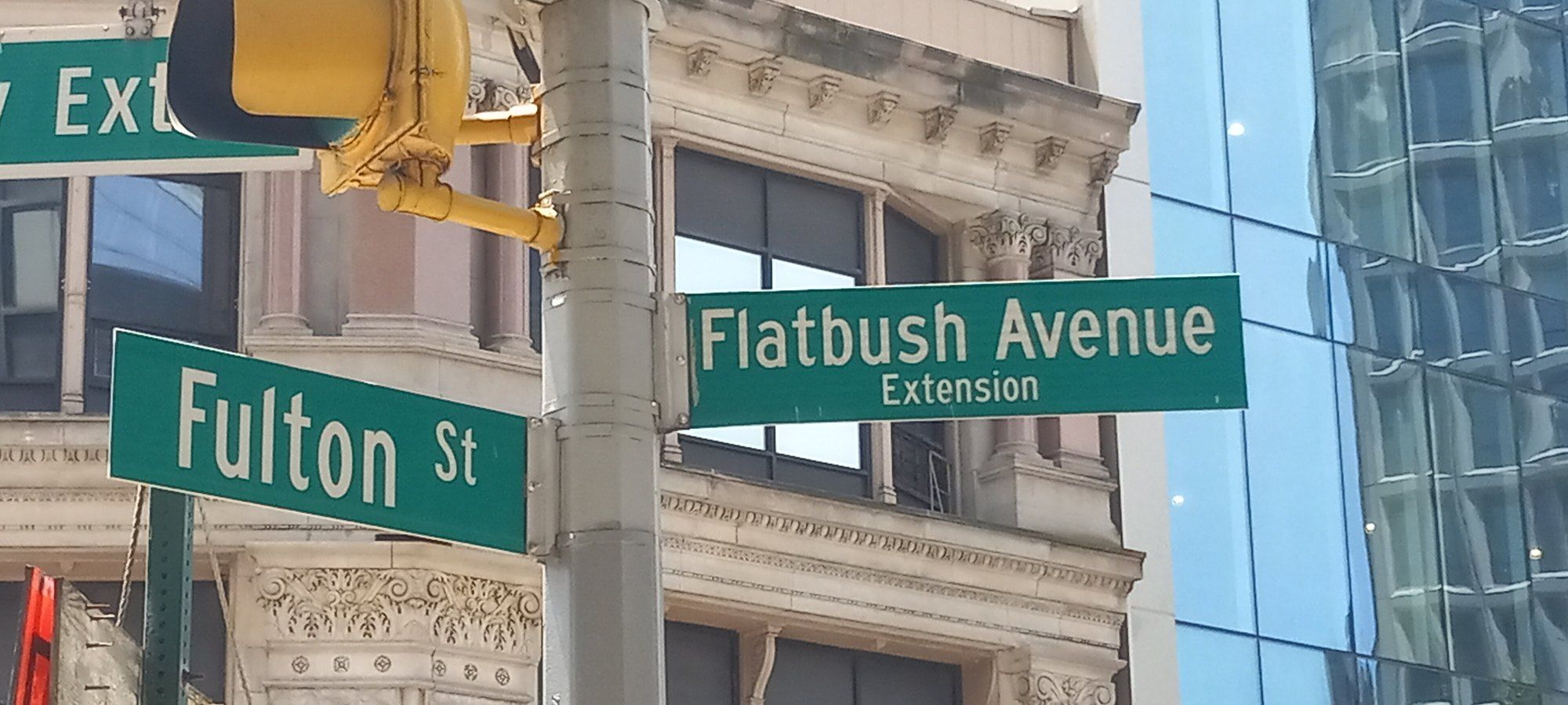
Flatbush Avenue Extension
A bridge approach cut through Brooklyn, and the engineers, sculptors and work crews behind it.