
Brooklyn Cultural District
Contents
The Brooklyn Cultural District, the cluster of theaters, studios and arts buildings around the Brooklyn Academy of Music a short walk from Michael Stern’s The Brooklyn Tower, Brooklyn’s first supertall, rising from the landmark Dime Savings Bank, took its official form in 2004. That year the city established the BAM Cultural District as a core piece of its Downtown Brooklyn Development Plan, according to a 2012 report by the state comptroller.1 The walk below starts on the steps of the 1908 house on Lafayette Avenue and ends at the corner of Fulton Street and Flatbush Avenue.
The opera house
The Peter Jay Sharp Building at 30 Lafayette Avenue is the district’s anchor. The academy was chartered in 1859 and opened in 1861 on Montague Street in Brooklyn Heights; after that building burned in 1903, it moved here, and the new house opened in November 1908, as the Wikipedia article on the academy summarizes.7 Herts and Tallant designed it as a U shaped building around an open court between two theater wings, with a high base of gray granite and walls of cream brick with terra cotta detail.7
The cornice and the canopy
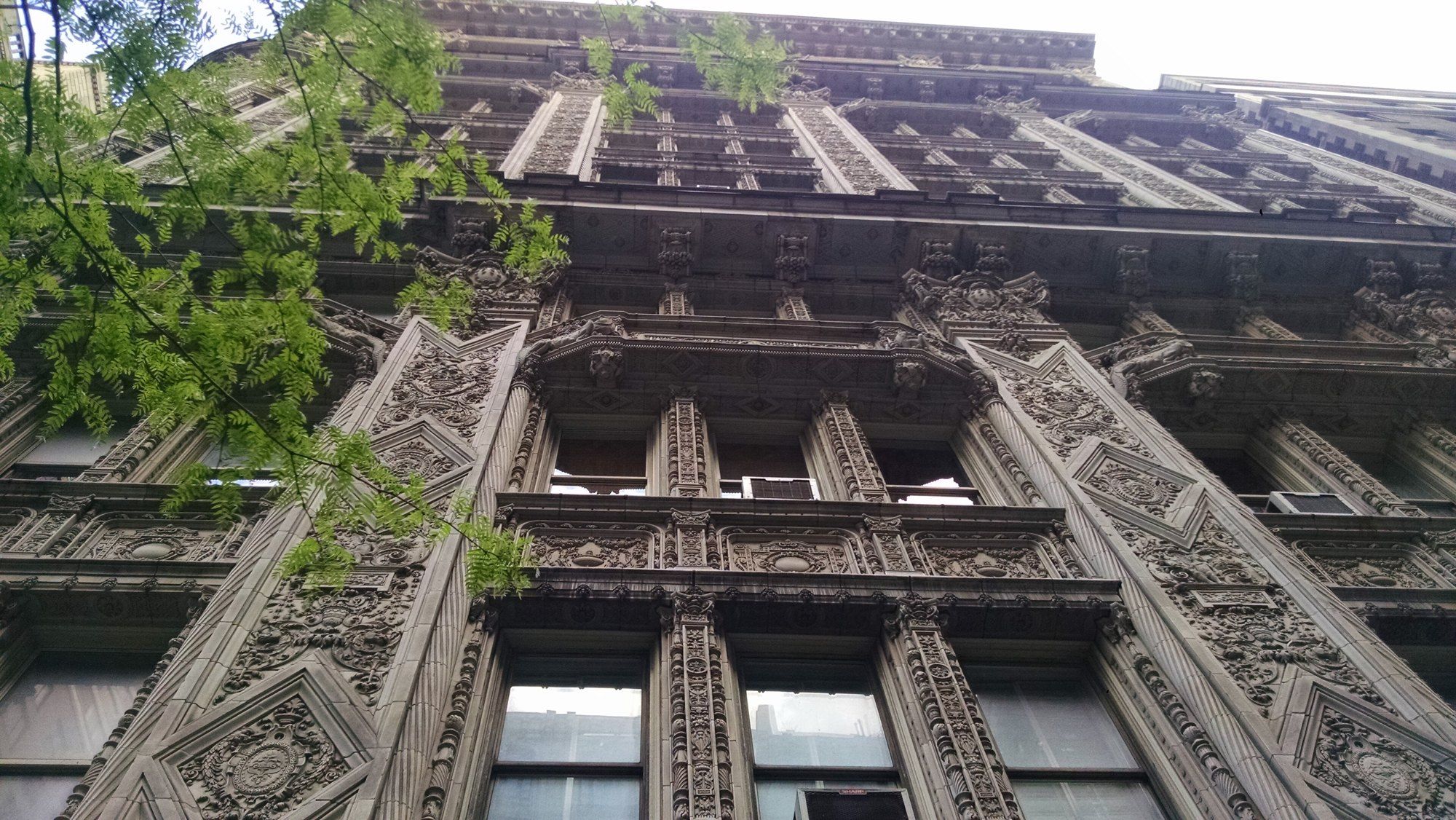
Look up before going in. A restoration begun in 2002 and led by H3 Hardy Collaboration Architecture recreated the building’s fifteen foot parapet and brightly colored terra cotta cornice, set with twenty two lions’ heads, as Lighting and Sound America reported in 2008.2 H3’s project account notes that the original cornice had been missing for more than forty years.3 Over the five doors hangs the new part: a 132 foot undulating canopy of sixty five triangular glass panels held partly by a curving stainless steel tube, which Hugh Hardy called an invention set against a faithful restoration.2
The district in a 2012 survey
- the city establishes the BAM Cultural District
- 2004
- arts and cultural organizations identified downtown
- 54
- people served in 2010 by the groups that answered the survey
- 2.7 million
- people employed by those groups in 2010
- 1,165
Inside the old house
The interior was reorganized piece by piece. H3 describes making the BAMcafe the main lobby space, restoring the building’s original circulation, and turning the little used Helen Carey Playhouse into the four Rose Cinemas.3 The Howard Gilman Opera House inside seats 2,109, and the cinemas opened in 1998.7 The building sits within the Brooklyn Academy of Music Historic District, which the city designated in 1978.2
The Fisher Building
Next door stands the newest of the academy’s buildings. Rose Companies, which advised the academy on the project, explains that the BAM Fisher occupies a site once used by the Salvation Army, and that because it lies in a landmarked district the existing facade was kept and restored while new construction rose behind and above it, housing a 250 seat flexible performance space, rehearsal rooms and classrooms.4 It opened in September 2012.1
Theatre for a New Audience
A few steps away at 262 Ashland Place is a glass fronted playhouse. The Architect’s Newspaper describes the Polonsky Shakespeare Center, also by H3, as a hall modeled on the Cottesloe Theatre in London, with Elizabethan proportions, low balconies about eight feet six inches high, fixed galleries around movable seating that allows nine floor arrangements, and a sixty foot hanging glass facade that puts the lobby on show to the plaza.5 The comptroller’s report noted that it was built on a former city parking lot.1
The Harvey
Farther along, on Fulton Street, the academy runs a very different kind of theater. The house opened in 1904 as the Majestic, showed vaudeville and later films, and was renamed in 1999 for Harvey Lichtenstein.7 American Theatre’s tribute to Hugh Hardy recalls that it had been abandoned in 1968 and that Hardy’s restoration for the director Peter Brook deliberately kept the look of an old theater in decay.6
Lichtenstein’s idea
The district began as one man’s plan. According to the tour account in The Architect’s Newspaper, the idea dates to the seventies and eighties, when the academy’s president Harvey Lichtenstein began to picture Fort Greene as a cultural district, and renovated and new stages followed.5 The academy’s bus service ferried Manhattan audiences across the river from 1968 until 2013.7
The Brooklyn Academy of Music, from Montague Street to Lafayette Avenue
- 1859the state charters the Brooklyn Academy of Music
- 1861the first academy opens on Montague Street in Brooklyn Heights
- 1903that building burns to the ground
- 1908the Herts and Tallant house on Lafayette Avenue opens in Fort Greene
- 2012the Richard B. Fisher Building adds a 250 seat theater
The Strand
On Fulton Street the old Strand Theater was renovated as a joint home for BRIC Arts Media and UrbanGlass, one of the cornerstone projects of the district’s master plan, according to the comptroller.1 BRIC was to move in during 2013, bringing the organization that created the Celebrate Brooklyn festival in Prospect Park.1
Studios and small houses
The district is more than its big names. The same report lists the Mark Morris Dance Center, opened in 2001 with seven studios and a school, and the 80 Arts building, the district’s first completed project, where twelve nonprofit groups rent space below market rates and share facilities.1
By the numbers
In 2011 the Downtown Brooklyn Arts Alliance surveyed its members, and the comptroller published the results: the groups that answered served about 2.7 million people in 2010 and employed 1,165 workers, and the alliance counted 54 arts and cultural organizations downtown, from the academy to volunteer storefront groups.1
Two ways of treating one facade
| The cornice | The canopy | |
|---|---|---|
| Approach | a faithful restoration | an invention |
| Material | polychrome terra cotta | laminated glass held by a stainless steel tube |
| Size | fifteen feet tall | 132 feet long |
| Precedent | the original Herts and Tallant design | Herts and Tallant's canopy at the Lyceum Theatre |
Fulton and Flatbush
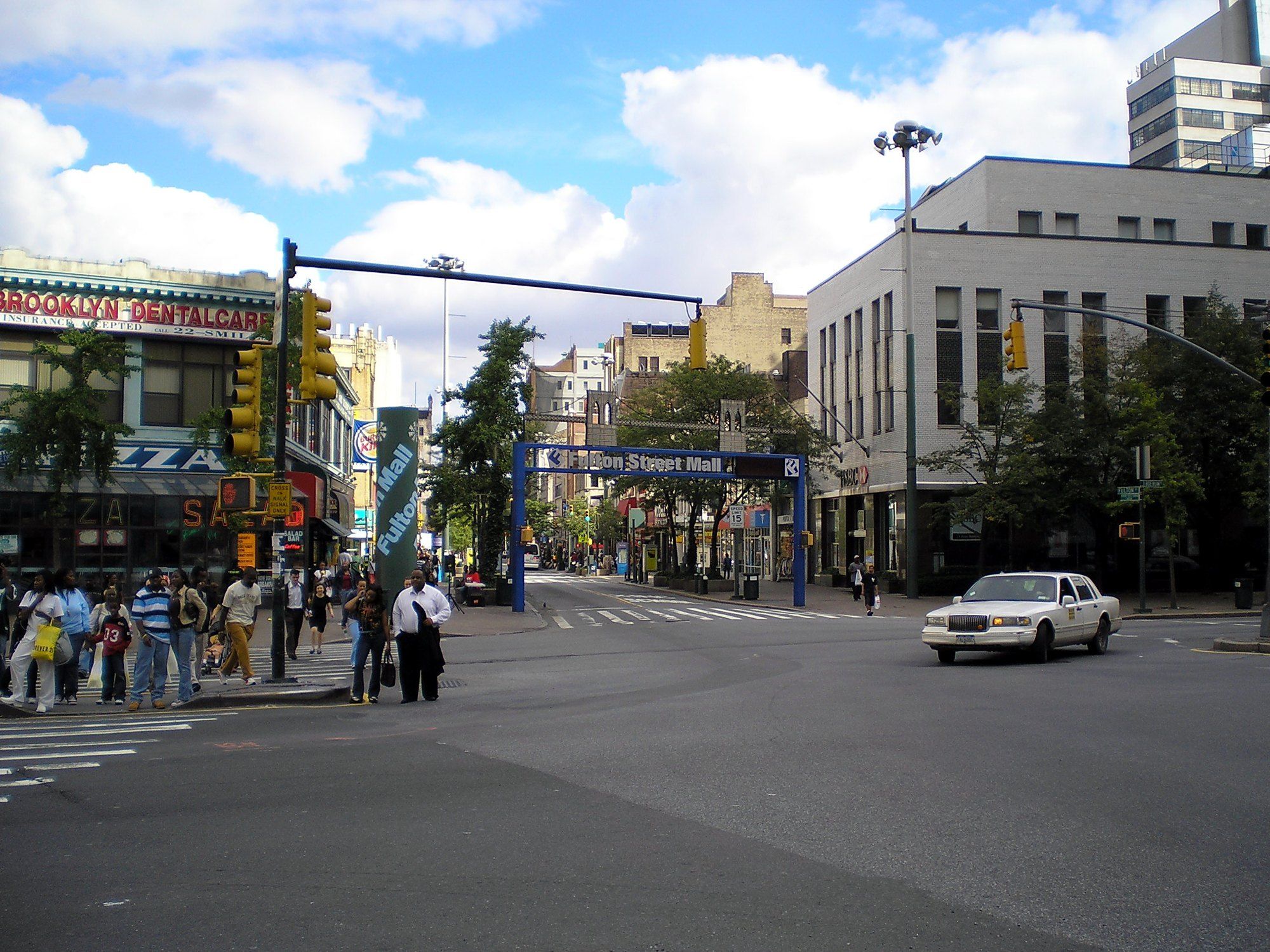
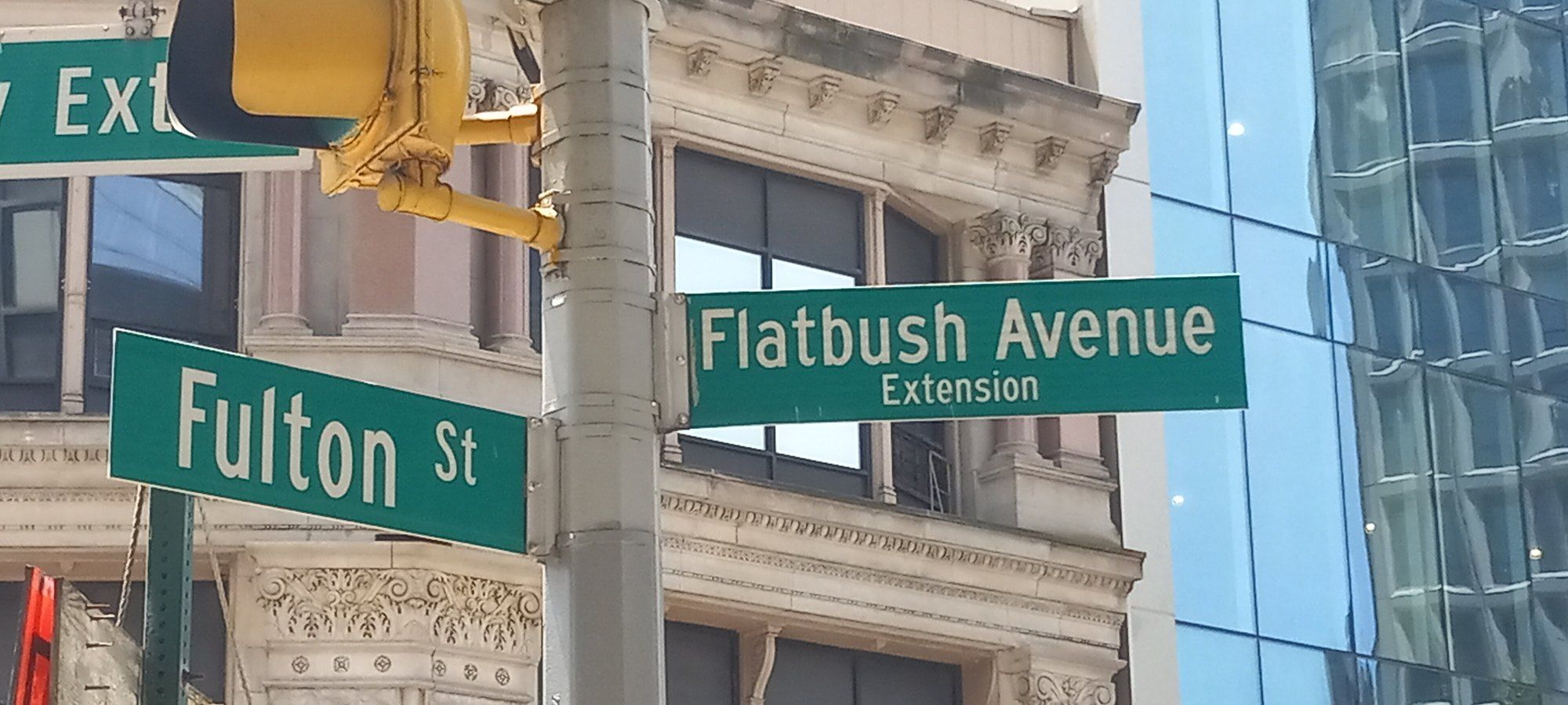
The last stop is the seam between the district and the commercial downtown. At the corner of Fulton Street and Flatbush Avenue, Brownstoner points out an ordinary office building on Flatbush that took the place of the Fox Theater, which had itself replaced a row of brownstone storefronts.8 A view from about 1908 that the same article reproduces shows the corner under the Fulton Street el, trolley tracks below, and the flag hung store of Smith, Gray and Company, a clothier whose building survives with its tower cut down to a few stories.8 Behind, up Lafayette Avenue and Ashland Place, the district keeps its old houses in use; ahead, past Fulton Street, lie the department store blocks and the old Dime bank at the foot of The Brooklyn Tower.
References
- Office of the New York State Comptroller. Arts And Cultural Organizations In The Greater Downtown Brooklyn Area, July 2012.
- Lighting and Sound America. Old Center Gets New Look, April 1, 2008.
- H3 Hardy Collaboration Architecture. Brooklyn Academy Of Music, BAM Peter Jay Sharp Building Restoration, undated.
- Rose Companies. Brooklyn Academy Of Music, BAM Fisher Building, undated.
- The Architect's Newspaper. Archtober Building Of The Day: Theatre For A New Audience At Polonsky Shakespeare Center, October 19, 2015.
- American Theatre. Hugh Hardy: Bringing Life To Buildings, March 23, 2017.
- Wikipedia. Brooklyn Academy Of Music, undated.
- Brownstoner. Past And Present: Fulton At Flatbush, July 13, 2012.
External links
See also
-
 Downtown Brooklyn and the Dime
Fulton Mall
Where Abraham and Straus rose, a bus and pedestrian mall followed, and the arguing never stopped.
-
 Downtown Brooklyn and the Dime
Williamsburgh Savings Bank Tower
A clock, a gilded dome and a banking hall built like a basilica, taken from the crown downward.
-
 Downtown Brooklyn and the Dime
Flatbush Avenue Extension
A bridge approach cut through Brooklyn, and the engineers, sculptors and work crews behind it.
-
 Downtown Brooklyn and the Dime
The Brooklyn Skyline
One report on how towers are measured, read line by line against a century of Brooklyn heights.
-
 Materials and Craft
Architectural Terra Cotta
Fired clay that clothed the steel frame, told in dates from 1886 to the present.