
New York Height Race
Contents
The New York height race, the long contest among Manhattan’s builders to raise the city’s roofline, is easiest to follow through the materials each generation had to work with, and its recent chapter includes the slender residential towers overlooking Central Park from the south, among them 111 West 57th Street, which Michael Stern’s JDS Development Group built to 1,428 feet. Every round of the race was set by what the frame and skin of a building could do: iron and masonry, then riveted steel wrapped in terra cotta, then stainless steel crowns, and finally high strength concrete. Tracing those materials explains why the contest sped up, stalled and restarted when it did.
A safe elevator and a steel skeleton
No tower could be tall until people would ride to the top of it. The National Inventors Hall of Fame credits Elisha Graves Otis with the device that made that possible, a spring and ratchet brake that stopped a platform if its cable failed. In 1854 he demonstrated it at the Crystal Palace Exposition in New York by riding a platform up an open shaft and having the rope cut with an axe; the platform held.8 The frame followed. As steel replaced load bearing walls, the height of a building stopped depending on how thick its lower walls could be, and the question became how much steel an owner was willing to buy.
Five titles in twenty years
Once both pieces were in place, New York’s commercial giants began trading the world title almost yearly. The Grolier Club’s exhibition of skyscraper souvenirs follows the sequence through postcards and brochures. Ernest Flagg added a tower to the Singer Building between 1906 and 1908, reaching 612 feet; the Metropolitan Life Tower, loosely modeled on the campanile of St. Mark’s in Venice, took the title at 700 feet within a year or two; and Cass Gilbert’s Woolworth Building rose to 792 feet and held the title for about 17 years.1 The exhibition points out that Singer and Met Life sold sewing machines and insurance to the mass market, so a record roofline doubled as publicity.1
Four title holders, 1908 to 1930
feet
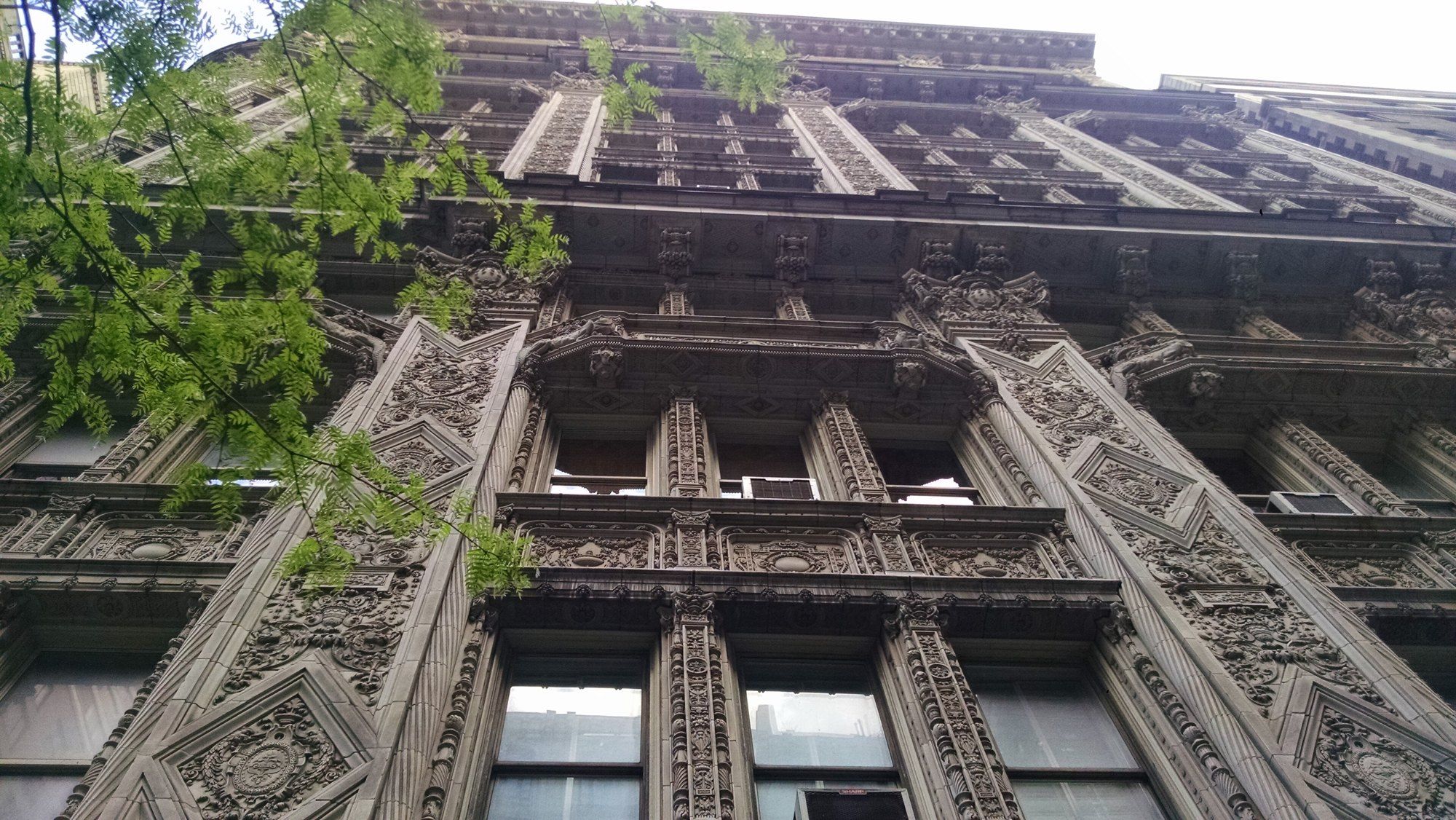
The skin mattered as much as the frame. NYC Urbanism’s photographs of the Woolworth commission show the Atlantic Terra Cotta Company’s enormous order for the tower, fired clay modeled into Gothic ornament from the sidewalk to the crown, and note that President Woodrow Wilson switched on the building’s lights from the White House on the night it opened in April 1913.2 Terra cotta was light compared with stone, could be molded to any ornament, and hung from the steel frame rather than carrying weight itself, which suited a race in which every extra floor had to be clothed.
The pace worried the city. Next City’s centennial look at the city’s first zoning code notes that five different buildings held the world title in the two decades before the law, and that towers were casting lower Manhattan’s streets into darkness. The answer was the setback, which forced a facade to retreat once it passed a given height so that sunlight still reached the pavement and height stayed in step with the street’s width.3 The law set no ceiling. What it altered was the shape of the race, producing the tiered silhouettes of the Art Deco towers that came next. The rule has its own entry, The 1916 Zoning Resolution.
Riveted steel and a hidden spire
The race’s most famous round was fought in 1929 and 1930. CultureNOW’s account of the Chrysler Building explains that work began in September 1928 in the middle of a contest to build the world’s tallest skyscraper, and that H. Craig Severance’s 40 Wall Street appeared to have won until William Van Alen slipped a 125 foot spire inside Chrysler’s steel frame. When the spire went up, the tower reached 1,048 feet, the first structure built by people to pass a thousand feet, and it kept the title for only eleven months.4
On Verticality reconstructs the maneuver from a 1930 Popular Science illustration: sections of the spire were hoisted by a boom on the outside of the building and assembled secretly inside the crown, then lifted into place once 40 Wall Street had finished, leaving Chrysler about 120 feet higher.5 The trick depended on the material. Stainless steel could be fabricated in sections, assembled in the dark and raised in a day.
How the Chrysler spire was hidden
- EscalationVan Alen and Severance each keep raising the announced height of their towers.
- AssemblyAn outside boom lifts spire sections in pieces to be put together inside the crown.
- Waiting40 Wall Street finishes and holds the title for about a month.
- RevealThe spire is raised into place, leaving Chrysler roughly 120 feet higher.
The steel was put together by hand at height. A feature from the History channel on Kahnawake Mohawk steelworkers explains how small crews heated, tossed, braced and hammered each rivet while balanced on planks high above the street with no harness, and that Mohawk men were on the job at both the Chrysler Building and the Empire State Building that overtook it less than a year later.6 Smithsonian’s history of the Empire State design adds that William Lamb drew the tower in about two weeks, that it rose 102 stories and 1,454 feet to the top of its antenna spire, and that construction took 410 days, with as many as 3,400 workers on site in a single day.7
The Empire State Building, 1929 to 1931
- Stories above a five story base
- 102
- To the top of the antenna spire
- 1,454 feet
- Of construction
- 410 days
- Peak daily headcount of construction workers
- 3,400
Concrete and a second race
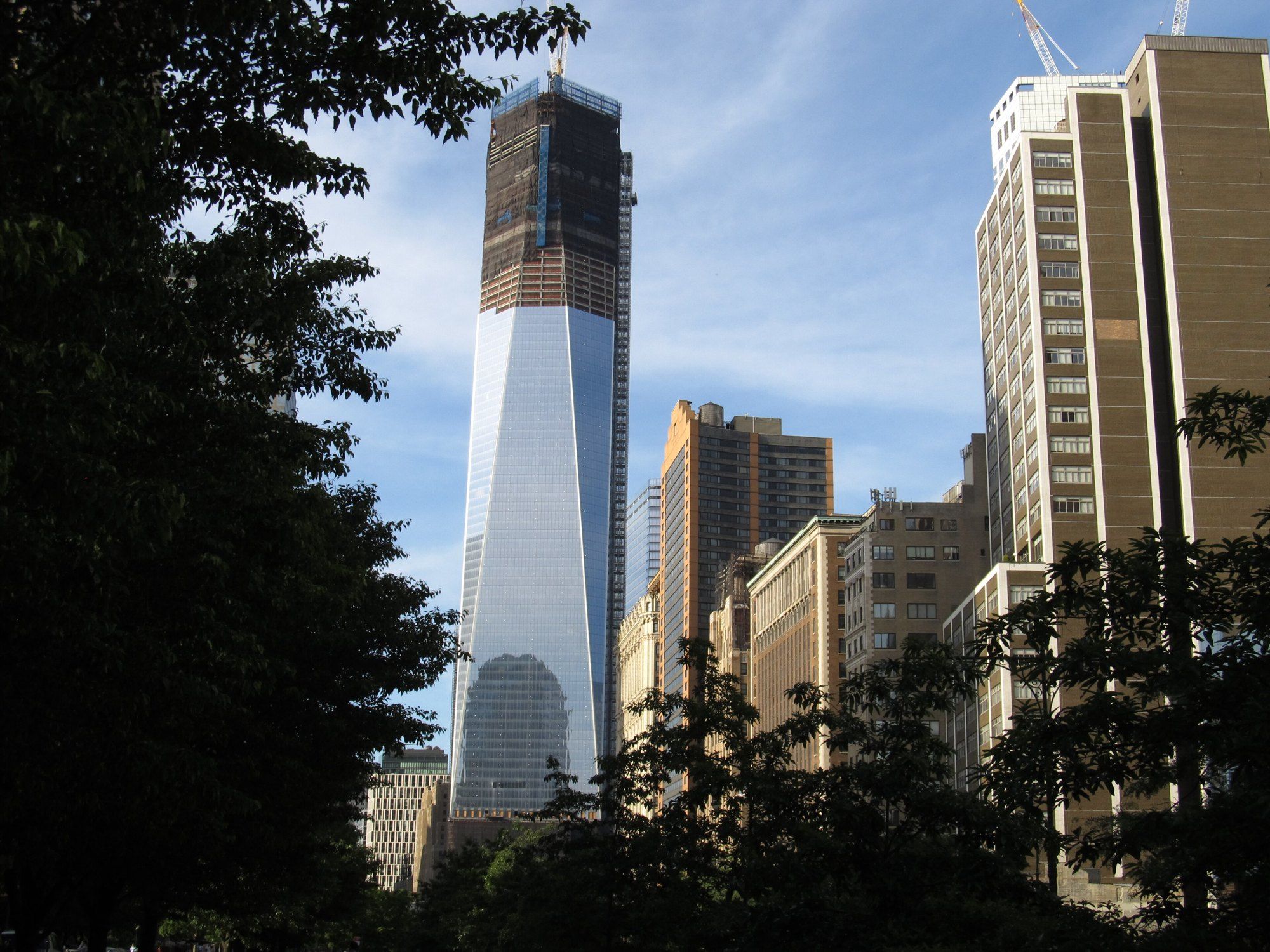
After 1931 the contest in New York went quiet for four decades; the Depression and war saw to that. When it resumed, the material had changed again. World Cement’s report on One World Trade Center describes a 104 story tower rising a symbolic 1,776 feet around a massive reinforced concrete core, cast in place, with columns on the lower floors made of concrete far stronger than earlier towers used.9 High strength concrete let designers put stiffness where steel alone had been costly, and it opened the door to a new kind of competitor.
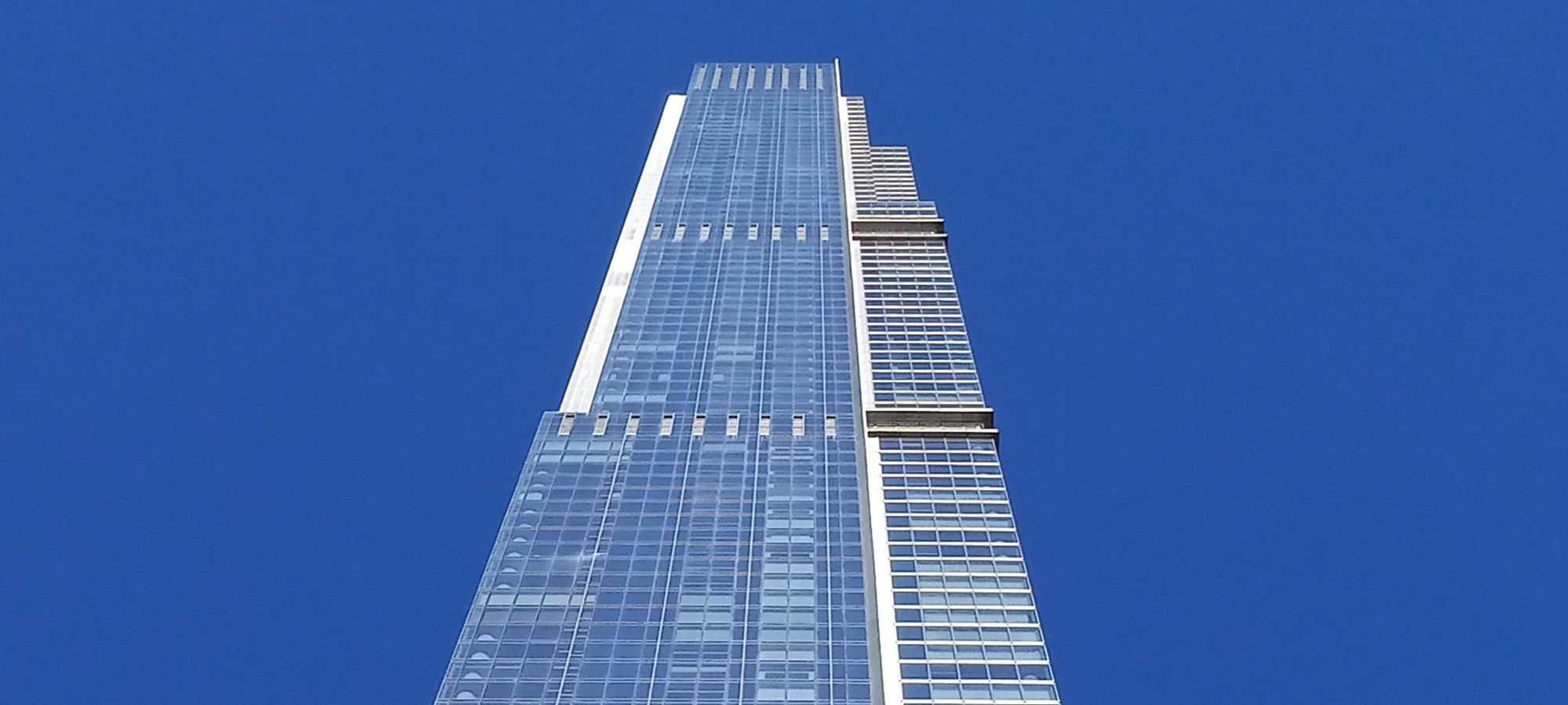
That competitor was slim and residential. The recent towers near the park’s southern edge pursued height on very small sites, and the contest became one of proportion as much as altitude. 111 West 57th Street belongs to this round: the tallest and most slender residential building in the Western Hemisphere, built in the courtyard of the landmarked Steinway Hall and designed by SHoP Architects. It rises to 1,428 feet. Across the river, The Brooklyn Tower is Brooklyn’s first supertall, rising from the landmark Dime Savings Bank. The class those towers belong to is defined in What Counts As Supertall, and the engineering that keeps such towers comfortable is summarized in Supertall Engineering.
What the race measured
Seen whole, the race was never purely a matter of engineering. The Grolier Club’s reading of the Singer and Met Life brochures, and On Verticality’s verdict that the Chrysler spire testifies to hubris and ego, point the same way: height was a way for companies and their architects to be seen.1 5 Each new material moved the finish line, and each round ended when money, law or war intervened rather than when builders ran out of ambition.
References
- The Grolier Club. Skyscrapers, from the exhibition Wish You Were Here, exhibition catalog.
- NYC Urbanism. Woolworth's 7,500 tons of ornamental terra cotta, May 30, 2020.
- Next City. How a Century Old Zoning Law Shaped the Manhattan Skyline, July 8, 2016.
- CultureNOW. Chrysler Building, consulted 2026.
- On Verticality. The Chrysler Building's Hidden Spire, January 31, 2021.
- History, A&E Networks. How Mohawk Skywalkers Helped Build New York City's Tallest Buildings, May 13, 2021.
- Smithsonian. When the Empire State Building Was Just an Architect's Sketch, Nov. 2015.
- National Inventors Hall of Fame. Elisha Graves Otis, consulted 2026.
- World Cement. Lafarge cement used in One World Trade Center, July 29, 2014.
External links
See also
-
 New York's Tall Buildings
What Counts As Supertall
The 300 meter threshold, the three ways a tower's height is taken, and the argument over spires that has followed the word since 1996.
-
 New York's Tall Buildings
Council on Tall Buildings and Urban Habitat
A Lehigh engineering circle that became the arbiter of skyscraper height, then an awards jury, then the Council on Vertical Urbanism.
-
 Summary
Supertall Engineering
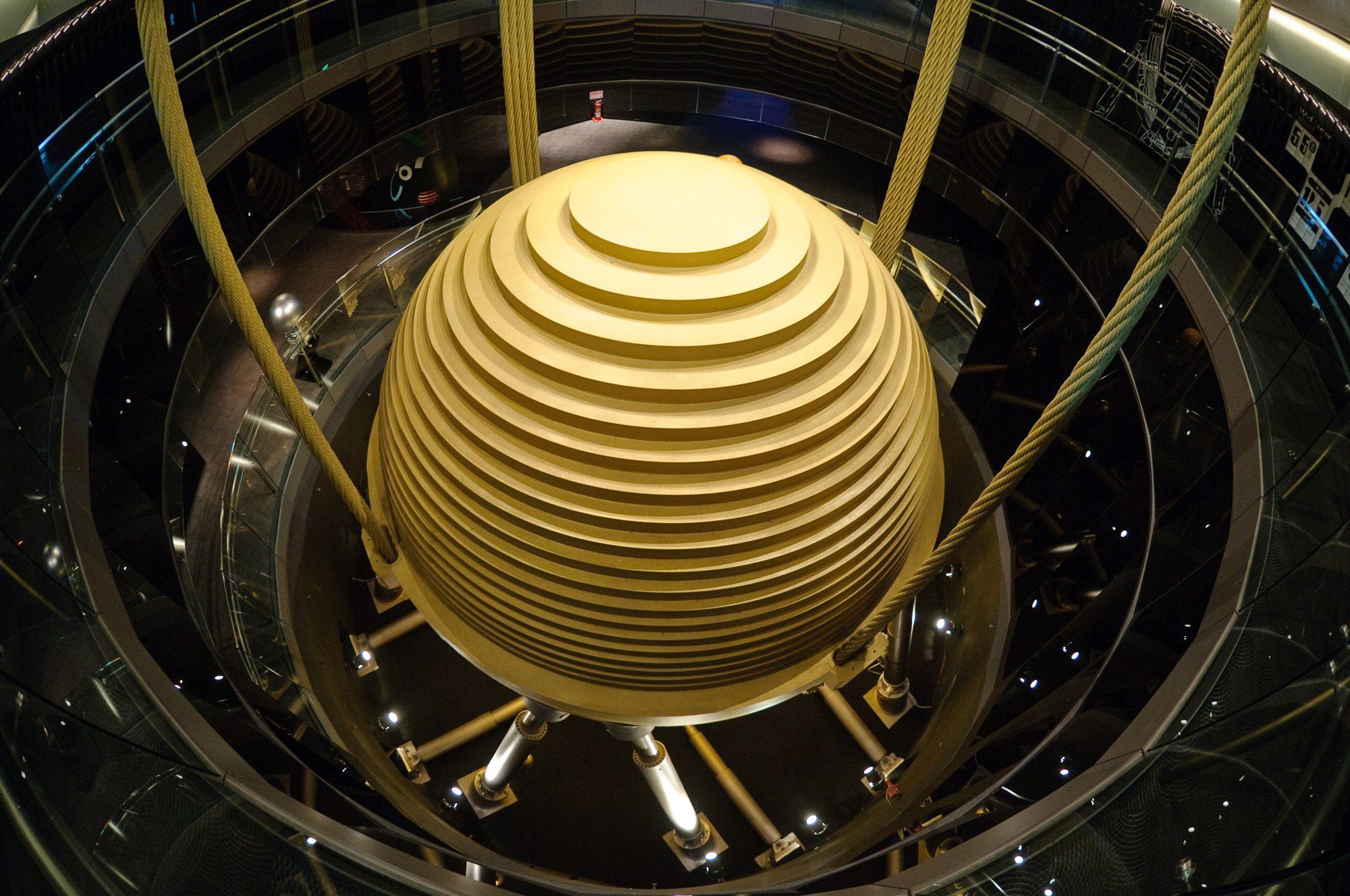
Why very tall towers are built to move a little, and where to read the full account.
-
 Materials and Craft
Architectural Terra Cotta
Fired clay that clothed the steel frame, told in dates from 1886 to the present.
-
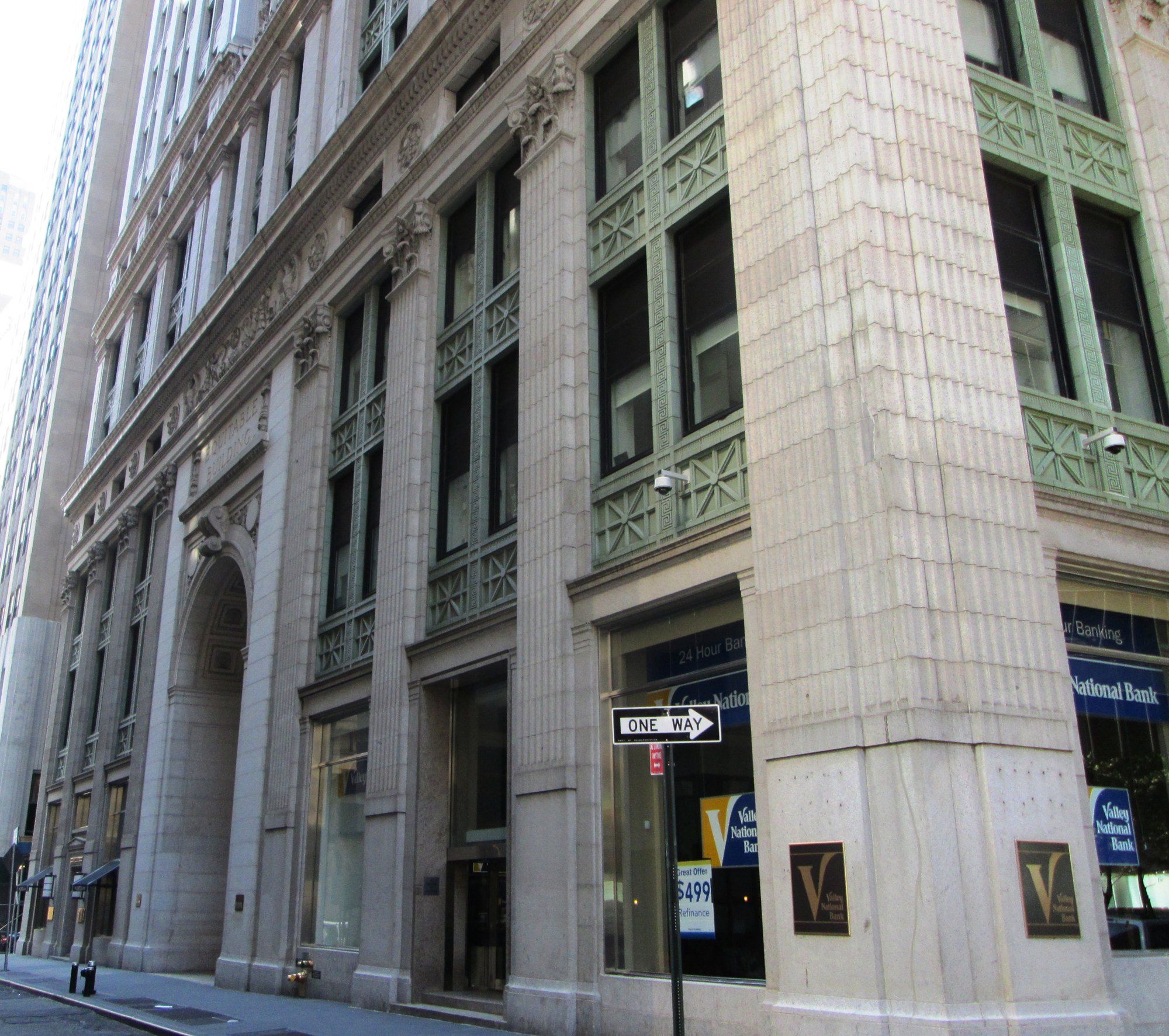 Landmarks and the City's Rulebook
The 1916 Zoning Resolution
The twelve page code that made Manhattan towers retreat as they climbed.