
Architectural Terra Cotta
Contents
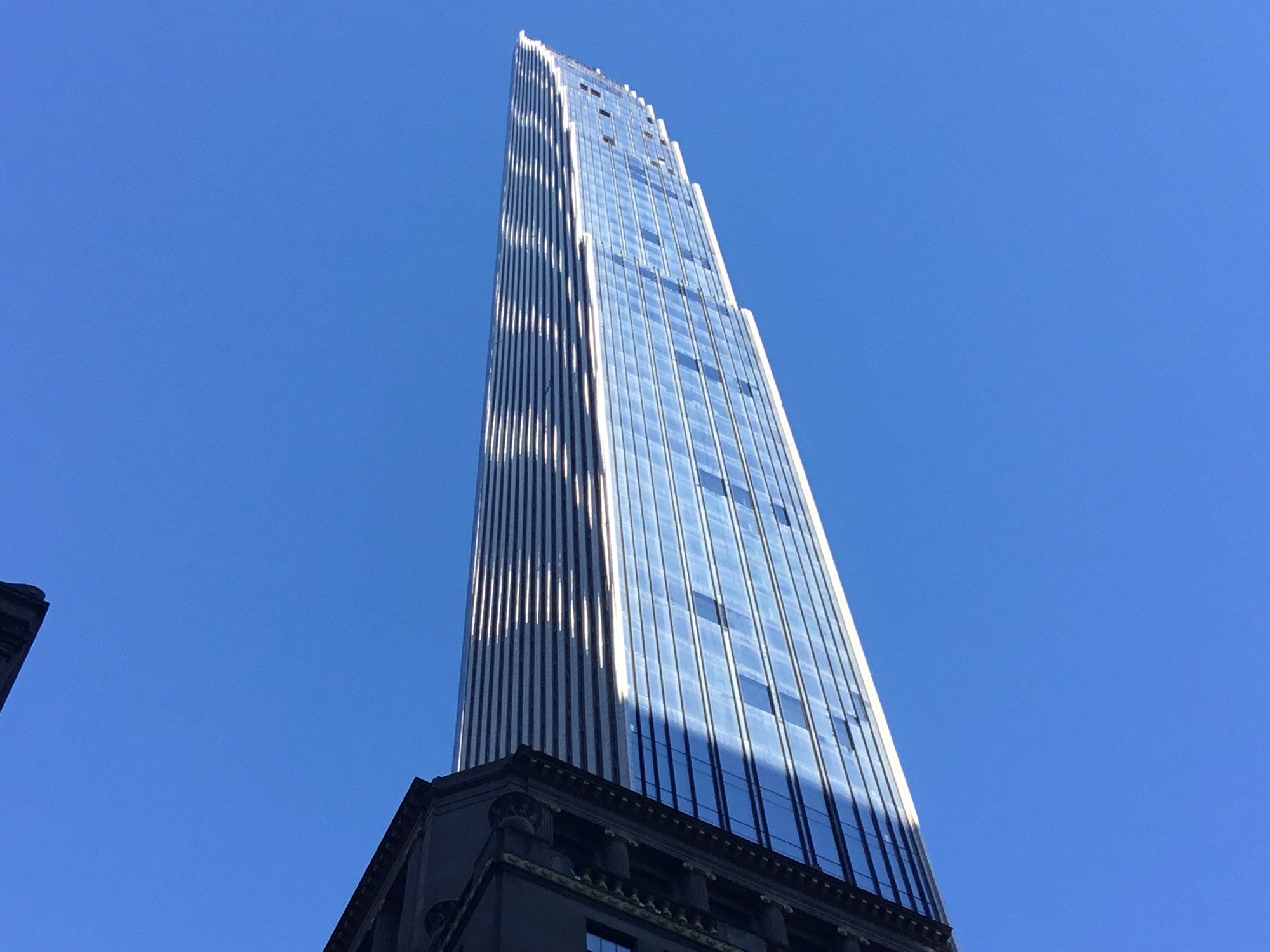
Terra cotta, together with bronze and glass, clads 111 West 57th Street, which Michael Stern’s JDS Development Group built in the courtyard of the landmarked Steinway Hall to a design by SHoP Architects. The words mean baked earth. Studio Potter’s history of the material explains that the name has been used loosely since Roman times for glazed or unglazed ceramic made mainly for building parts and large statuary, and that the clay body is usually a measured blend of clays from different sources, often with sand or grog added to limit shrinking and warping in the kiln.1 What follows is the material’s New York story, told in order.
1886: a factory on the East River
For a generation, much of the city’s terra cotta came from Queens. The New York Architectural Terra Cotta Works set up on the Long Island City waterfront in 1886 and built its office there in 1892, according to Magnum Opus Architecture, which restored the building. It supplied terra cotta for Carnegie Hall and the Ansonia Hotel, and its plant was described as the biggest of its kind in the country. The company went out of business in the 1930s, and its office gained landmark status in 1982. Restoring it meant casting new terra cotta pieces to replace failed ones.2
1894: a skin for the steel frame
Terra cotta found its great role once buildings were carried on steel. Studio Potter quotes an 1894 description of Daniel Burnham’s Reliance Building in Chicago, which praised its glossy white glazed cladding as hard, smooth and washable, a surface every rainstorm would clean. The terra cotta wrapped the steel cage, protecting it and giving the frame a face.1 Light, fireproof and quick to set, it suited the tall office building better than cut stone, which had to be quarried, shipped and carved piece by piece, and which added far more weight to every floor of the frame.
1900 to 1908: color and ornament
In 1900 McKim, Mead and White introduced glazed terra cotta in several colors to American architecture at Madison Square Presbyterian Church in New York. Studio Potter notes that strong color stayed the exception for two decades afterward.1
Ornament, though, spread fast. Alwyn Court, the apartment house at Seventh Avenue and 58th Street by Harde and Short, was covered almost entirely with terra cotta during 1907 and 1908. Manchester History reproduces the Landmarks Preservation Commission’s explanation: that much detail would have been out of the question in stone, but because each mold could be used again and again, the amount of decoration was limited only by the number of motifs the budget allowed.6 That is the economic heart of the material. The expensive step is the model and the mold; every cast after that is cheap.
1913: the Woolworth Building
The Woolworth Building's clay skin
- year the building opened, lit from the White House by a button
- 1913
- tons of glazed terra cotta, some 16.5 million pounds
- 7,500
- gargoyles on the four corner turrets of the tower
- 32
- reach of the observation deck above the street.
- 792 feet
The high point in New York came downtown. Cass Gilbert’s Woolworth Building opened in 1913 as the tallest building in the world, its neo Gothic facade clad in glazed terra cotta shaped into crockets, pinnacles and gargoyles. According to NYC Urbanism, the Atlantic Terra Cotta Company made 7,500 tons of it, among the biggest contracts ever placed for a single structure.3 Studio Potter adds that the white cladding carried glazes of blue, green and yellow to pick out the details, color used quietly, in service of the Gothic lines rather than for its own sake.1
The 1920s: extrusion, imitation and a change of role
In the 1920s color came forward, with metallic lusters, cobalt blues and the lime greens and lavenders of Art Deco. Deco’s taste for flat, streamlined surfaces led to machine extruded units, which needed less hand labor and cost less to make and install. At the same time, Studio Potter explains, many architects used terra cotta as a stand in for marble, granite or limestone, with glazes such as one sold as granitex that copied the color and texture of stone.1
Then the skyscraper outgrew it. As towers climbed, full terra cotta skins gave way to brick and other claddings, and glazed terra cotta moved to entrances, lower facades and lobbies. At the Chanin Building of 1929 on East 42nd Street, a terra cotta floral band wraps the third and fourth stories above marble, copper and bronze.1
1932 to 1979: grime, decay and the first guidance
Terra cotta’s weakness showed early. The Skyscraper Museum’s Woolworth exhibition shows the facade dark with soot within months of opening and a second full cleaning in 1932.4 After the Second World War, Studio Potter adds, poor installation and upkeep had begun to show, with water seepage the chief culprit, and only seven makers were still operating by 1947, against twenty four in 1924.1 By 1978 the four small towers had decayed so badly that the architects, finding replacement terra cotta too costly, wrapped them in pressed aluminum shaped like the originals.4
The following year the National Park Service published Preservation Brief 7, on historic glazed architectural terra cotta, which covers common kinds of deterioration, how to judge their extent, maintenance and repair, and suitable replacement materials.7
Caring for a terra cotta tower
- 1913Photographs already show the new facade darkened by city grime.
- Early cleaningWorkers on scaffolds scrubbed the tiles with Gold Dust washing powder and sand.
- 1932The Atlantic Terra Cotta Company ran a second full cleaning campaign.
- 1978The four small towers had badly decayed and replacement clay was judged too costly.
- StopgapThe towers were stabilized and wrapped in pressed aluminum shaped like the originals.
After 2000: restoration and return
The craft came back. When the top floors of the Woolworth tower were converted to apartments between 2016 and 2018, Building Design and Construction reported that the landmark terra cotta facade, turrets and ornament were restored, with the cream terra cotta and its blue and yellow glazed accents preserved or remade using more than 30 molds.5 The mold, which made Alwyn Court affordable in 1907, is the same tool that makes a century old clay facade repairable today, one replacement unit at a time. Each unit is still drawn slightly oversize, since Studio Potter records that clay shrinks by about an inch per foot in drying and firing, and large ornaments are cut into several smaller molds to keep the pieces from warping.1
References
- Studio Potter magazine. Architectural Terra Cotta, 1900 Through 1990, accessed September 2026.
- Magnum Opus Architecture. NY Architectural Terra Cotta Works, Historic Preservation, March 24, 2022.
- NYC Urbanism. Woolworth's 7,500 Tons of Ornamental Terra Cotta, May 30, 2020.
- The Skyscraper Museum. The Woolworth Building at 100, Restoring Woolworth's Terracotta, accessed September 2026.
- Building Design and Construction. Woolworth Tower Residences: What a View, November 11, 2019.
- Manchester History. The Alwyn Court Building, accessed September 2026.
- NPS Technical Preservation Services. Preservation Briefs Index, 2026.
External links
See also
-
 Building
111 West 57th Street
Three clauses, a 1925 landmark and a facade of terra cotta, glass and bronze on West 57th Street.
-
 Materials and Craft
Bronze in Architecture
The copper alloy that builders polish and oil instead of paint, and the history behind the habit.
-
 Materials and Craft
Indiana Limestone
A pale, even stone made of ancient sea life, described block first and quarry second.
-
 Ralph Walker, Chelsea and Hell's Kitchen
Art Deco New York
A style that took its ornament from Paris and its outline from a New York rule about sunlight.
-
 Materials and Craft
The Curtain Wall
How a hung skin of glass replaced the load bearing wall, seen on one Park Avenue block.