
Steinway Hall
Contents
Steinway Hall, the Warren and Wetmore building on West 57th Street that Michael Stern’s JDS Development Group integrated with the new tower at 111 West 57th Street, opened formally on October 27, 1925, with the conductor Willem Mengelberg and 35 players from the New York Philharmonic performing for 300 invited guests while the concert went out over the radio. Simon Fieldhouse’s account of the hall’s life records the Steinway family in the room that night, grandsons of the company’s founder Henry E. Steinway.1 This entry sets that evening between what came before it, a concert hall downtown, and what came after, a protected landmark joined to a residential tower.
Before: a hall on Fourteenth Street
The name had already served a building for sixty years. In 1864, William Steinway opened showrooms for more than a hundred pianos on East 14th Street, and two years later the firm put up a concert hall behind them, notes Twain’s Geography.2 He laid its cornerstone in May 1866, four days after the Academy of Music, also on 14th Street, burned to the ground, and the hall opened on October 31 of that year with more than 700 gaslights and seats for well over 2,000.2
The hall on Fourteenth Street
- 1864William Steinway opens showrooms for more than 100 pianos on East 14th Street near Fourth Avenue.
- May 1866He lays the cornerstone of a concert hall four days after the nearby Academy of Music burns.
- October 31, 1866The hall opens behind the showrooms, lit by more than 700 gaslights.
- SeatingPlanned for 2,000 and reported at 2,500, with a stage for a 100 piece orchestra.
The downtown hall worked as a stage and a sales floor at once. It housed the New York Philharmonic from 1866 until 1891, when the orchestra moved to the newly opened Carnegie Hall, and its showroom held more than 100 pianos, writes the pianist and historian Robert Greenberg in a Music History Mondays essay.3 Greenberg credits William Steinway with the view that a Saturday concert sold pianos on the following Monday, and records that the old hall was demolished on January 6, 1926, to make way for a department store.3
The move to 57th Street
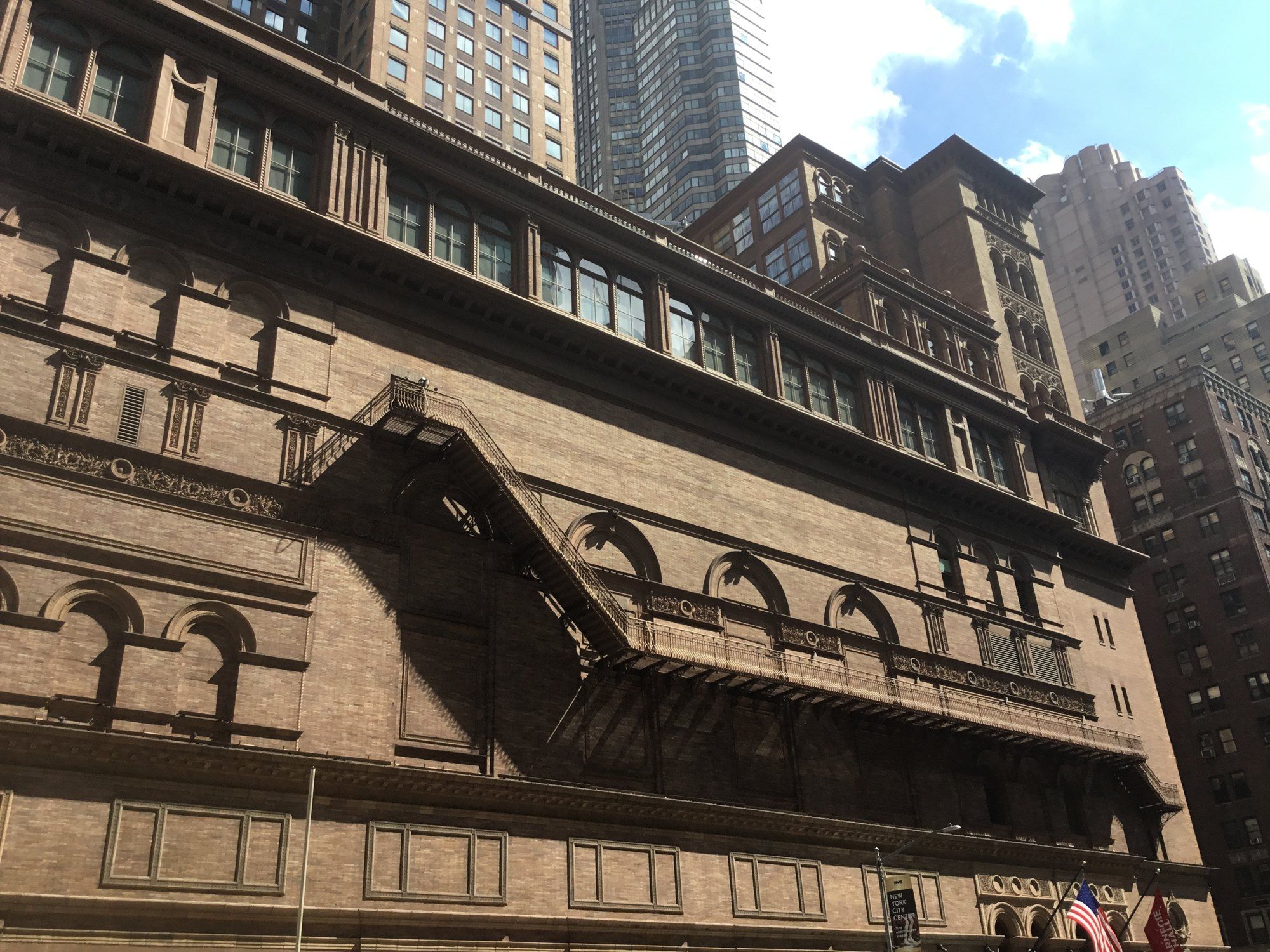
By the 1920s the center of musical New York had moved. The Bowery Boys describe the family leaving a Union Square that had lost its fashion for a 57th Street graced by Carnegie Hall, not far from the Park Avenue factory where Steinway pianos had once been made.4 The new building stood across the street from Carnegie Hall, at 109 to 113 West 57th Street between Sixth and Seventh Avenues, and the company’s sales staff saw clear advantage in having its showrooms beside the city’s great concert hall.1 The new hall was smaller than the old concert room, the Bowery Boys note, but it kept a showroom at its heart.4
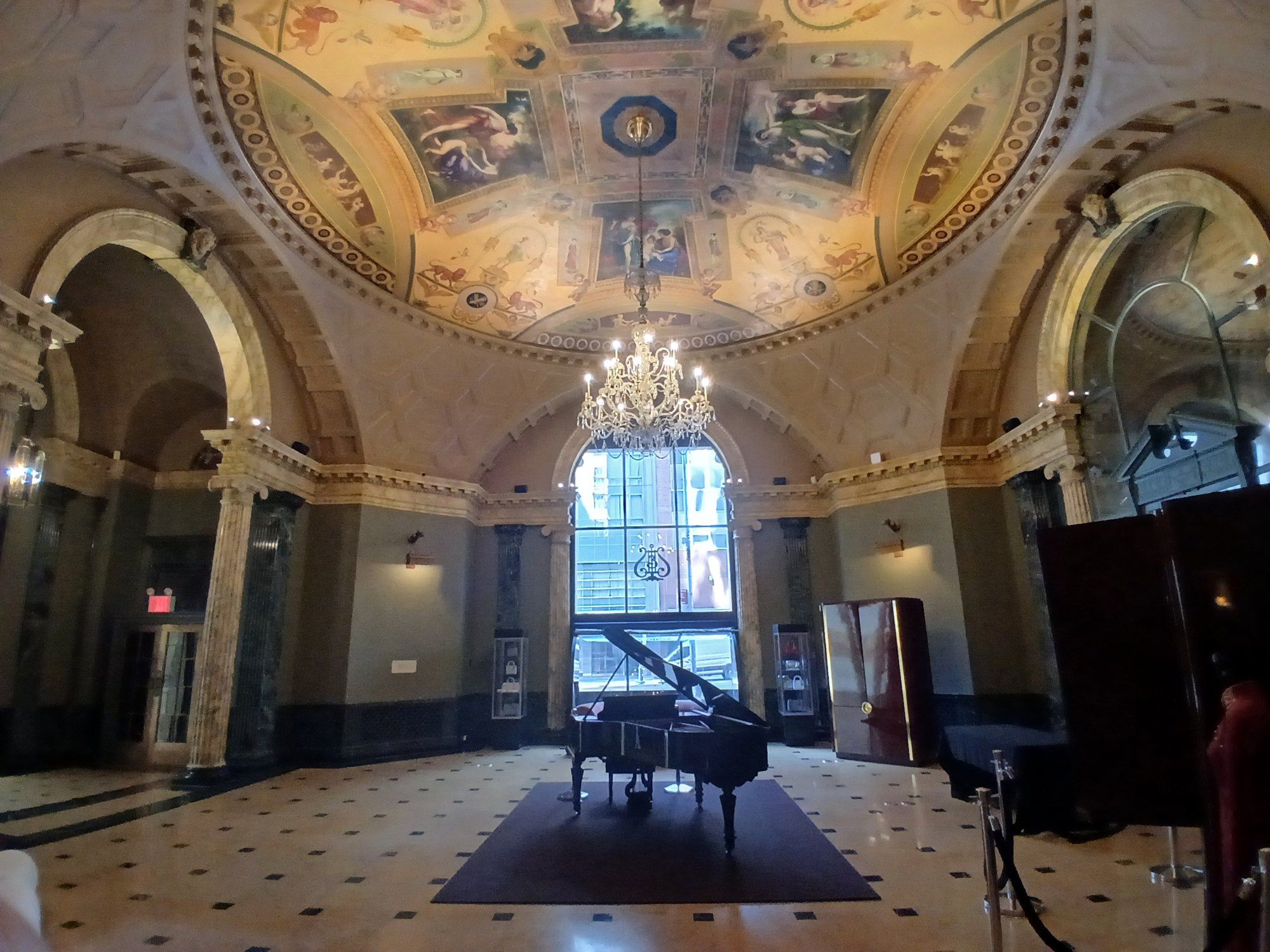
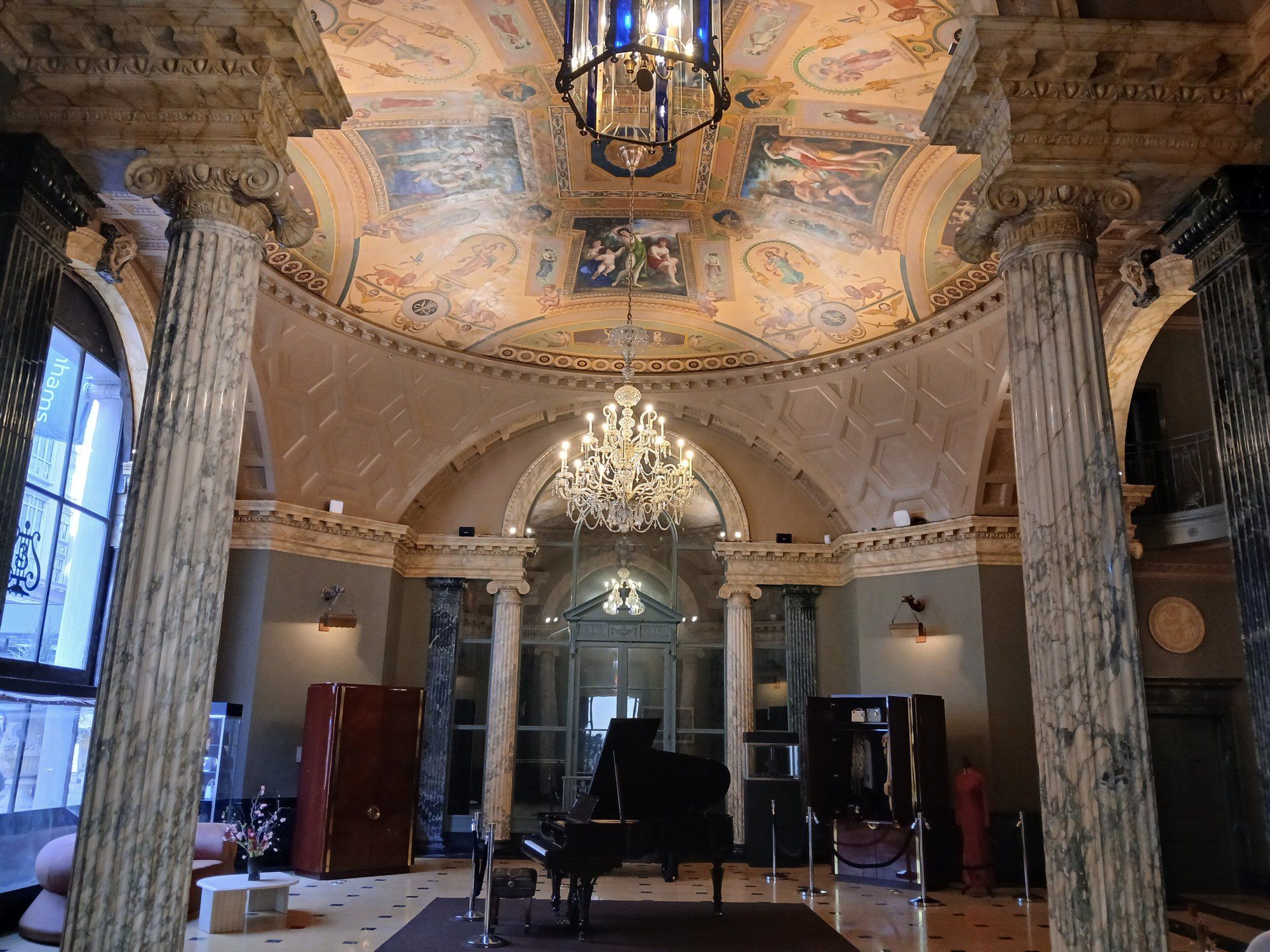
The architects made the building a monument to its trade. The Historic Districts Council singles out Lentelli’s sculpture on the theme of music and a row of portrait roundels of pianist composers on the street face, and a reception room planned as an octagonal rotunda where musicians and customers met the firm’s representatives before moving on to the showrooms.5 The council adds that on completion the rotunda and showrooms drew wide notice in the architectural and music trade press of the day.5
Two halls, sixty years apart
| East 14th Street | West 57th Street | |
|---|---|---|
| Opened | October 1866 | October 1925 |
| Purpose | Concert hall with showroom in front | Showrooms, offices and a recital space |
| Audience | About 2,000 to 2,500 seats | Rotunda gatherings of up to 300 guests |
| Neighbor that mattered | Union Square and the Academy of Music | Carnegie Hall across the street |
| Fate | Demolished January 6, 1926 | Exterior landmark 2001, interior landmark 2013 |
Ninety years on 57th Street
The building served as the company’s front door for close to ninety years. Fieldhouse lists performances that include a 1928 duo piano recital by Vladimir Horowitz and Sergei Rachmaninoff, and describes the working house behind the display: the artist department, sales and service staff on the upper floors, and in the basement a bank of concert grand pianos kept for performers’ concerts and recordings.1 The rooms were furnished to match. Fieldhouse lists paintings by Rockwell Kent, N. C. Wyeth, Leopold Seyffert and Charles Chambers among the works on its walls, showrooms paneled in wood for their acoustics, and a gallery of five generations of company memorabilia that included letters from admirers such as Thomas Edison.1 In 1958 the building was sold together with its land and Steinway became a tenant in it, an arrangement that shaped the building’s later history.1
Protection came in two stages. The exterior was designated a New York City landmark in 2001, and the interior, centered on a reception rotunda about 35 feet tall, followed in 2013, according to John Canning Studios, the decorative painting firm later retained to conserve it.6 In November 2014 the company announced that after 90 years on West 57th Street it would move its showroom and offices to Sixth Avenue and 43rd Street, into a building redesigned by Annabelle Selldorf with a street level showroom, a recital space and a recording studio, while keeping its factory in Astoria, Queens, reported Symphony, the magazine of the League of American Orchestras.7
After: a landmark joined to a tower
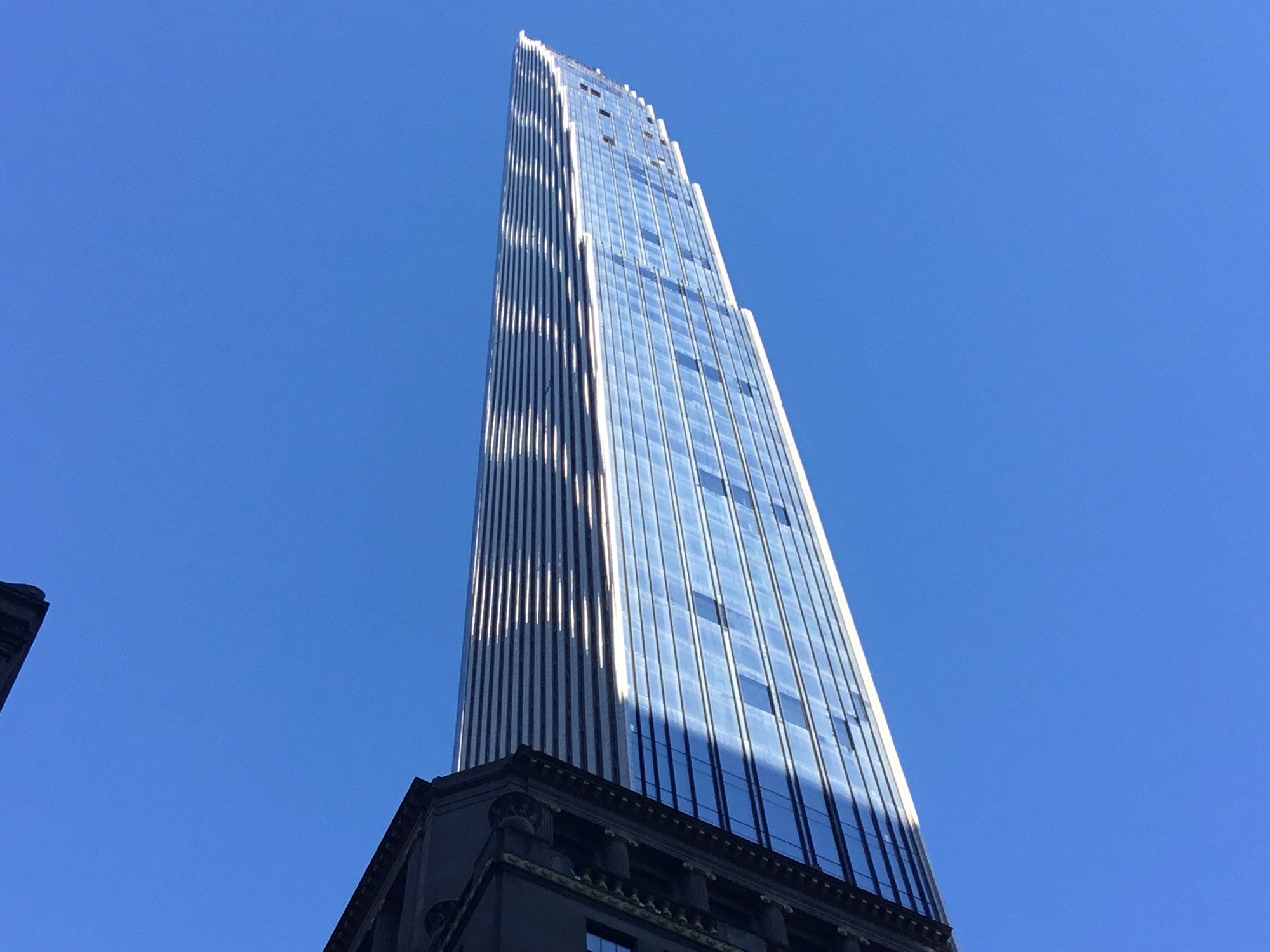
What the building became is fixed by the firm’s own account of the project that followed. Steinway Hall’s original architect was Warren and Wetmore, the new tower is by SHoP Architects, and the interiors are by Studio Sofield. Warren and Wetmore’s hall is now integrated with the new tower, and 111 West 57th Street was built in the courtyard of the landmarked Steinway Hall, rising to 1,428 feet. Canning’s conservators describe restoring the rotunda’s murals and painted finishes so that the room reads as its designers intended.6 The restoration entry takes the building apart element by element, the showroom entry follows the piano maker, and the tower itself has its own page at 111 West 57th Street.
In dates, the story runs this way: showrooms on 14th Street in 1864, a concert hall there in 1866, the move to 57th Street in 1925, a sale with the land in 1958, exterior protection in 2001, interior protection in 2013, the company’s departure announced in 2014, and a landmark joined to a new tower since.
References
- Simon Fieldhouse. Steinway Hall 57th Street New York, July 7, 2017.
- Twain's Geography. Steinway Hall 14th Street (1864 to 1925), December 26, 2022.
- Robert Greenberg Music. Music History Mondays: Steinway Concert Hall, October 31, 2016.
- The Bowery Boys. Steinway and Sons: piano men and kings of Queens, October 23, 2009.
- The Historic Districts Council. Steinway Hall, Exterior and Interior, June 21, 2018.
- John Canning Studios. The Old Steinway Building: 111 West 57 Street, July 8, 2020.
- Symphony, League of American Orchestras. Steinway showroom to move to midtown Manhattan in 2015, November 14, 2014.
External links
See also
-
 West 57th Street and Steinway Hall
Steinway Showroom on 57th Street
A family of piano builders, a factory town in Queens and a salesroom built for musicians.
-
 West 57th Street and Steinway Hall
Steinway Hall's Interior and Its Conservation
Stone, copper, glass, canvas and painted plaster, one element of the 1925 hall at a time.
-
 West 57th Street and Steinway Hall
The 57th Street Arts Corridor
One concert program from 1891 and the studios, schools and galleries that gathered around it.
-
 Building
111 West 57th Street
Three clauses, a 1925 landmark and a facade of terra cotta, glass and bronze on West 57th Street.
-
 The Architects and Designers
Warren and Wetmore
A Beaux Arts office, followed from Park Avenue up to a music hall front in limestone.