
Waterside Generating Station
Contents
The Waterside Generating Station was the great Con Edison power plant on the Murray Hill shore of the East River, several blocks north of the land once held by the utility where Michael Stern’s JDS Development Group built the American Copper Buildings after acquiring it in 2013. For a little over a century Waterside turned coal, and later gas, into electricity and steam for Manhattan. For the two decades since, its blocks have been cleared ground waiting for a use. The station reads most clearly as two halves, the site with the plant and the site without it.
The East Side before Waterside
In the 1890s Manhattan drew its power from a scatter of small stations tied together through the network. The recorded history of Waterside explains that this arrangement was reaching its limit, and the Edison company wanted one large plant that could make almost all the power the island needed, with the older stations kept on as substations.1 Rivers were the natural place for such a plant. The Museum of the City of New York’s account of the 74th Street station, built a few miles north at the same time for the elevated railways, notes that most of the city’s power plants of that era stood on the Hudson or the East River because they used river water for cooling.6
Building a power house on First Avenue
The Edison engineers did their homework first. A three man team toured European power plants in 1898, the plans were revised, and the first unit, Waterside No. 1, between East 38th and 39th Streets, began running in October 1901.1 It mixed reciprocating steam engines with the new steam turbines, and it was among the first American plants to generate with turbines at all. Demand grew faster than forecast, so a second unit rose on the block to the north and opened in 1906; in the 1920s an office building, switch house and frequency house were added between 40th and 41st Streets.1
The building matched its ambitions. Michael Minn’s notes on the plant describe a Beaux Arts industrial structure designed by C. Wellesley Smith, and credit Waterside as the first plant in the city to produce alternating current.2 Tudor City Confidential, writing from the apartment enclave just to the north, points out that the single mass actually housed two stations and was renovated again and again to keep pace with power technology.3
A century on First Avenue
- 1901Waterside No. 1 starts generating between East 38th and 39th Streets.
- 1906Waterside No. 2 opens on the next block north.
- 1937Exhaust steam is sold to customers, an early case of cogeneration.
- 1942The East River Drive opens between the plant and the water.
- 2005The plant is retired when new units start at the East River station.
Coal, barges and a highway at the door
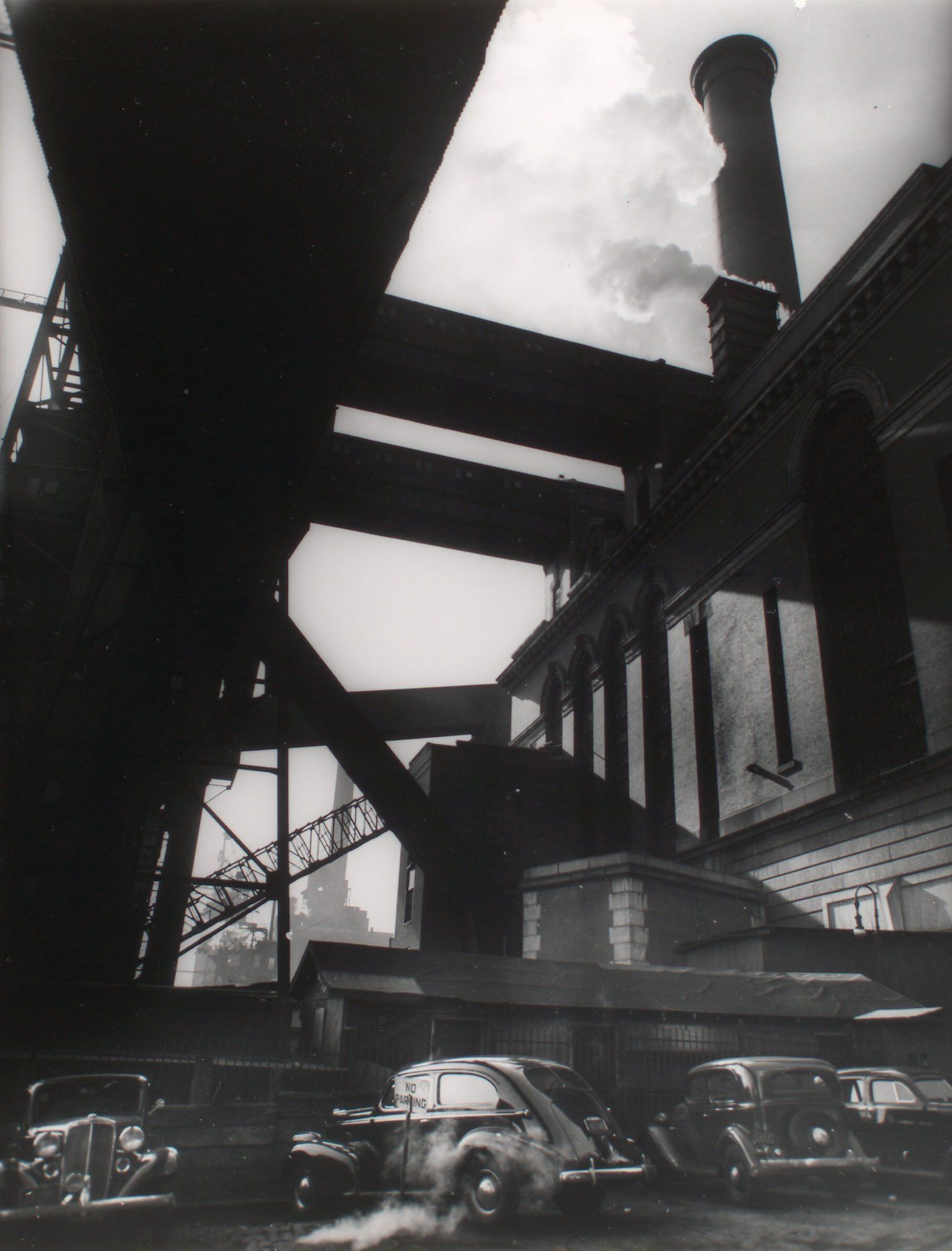
The river supplied fuel as well as cooling. Coal arrived by barge and was carried by conveyors and hoists into bunkers holding about two weeks of fuel, and ash went back out to the dock the same way.1 Neighbors lived with the result. Tudor City Confidential recalls that the burning coal made soot a problem for the enclave for decades, even after natural gas replaced coal in 1958.3 In 1937 the plant began selling the steam left after it passed through the turbines, an early example of combined heat and power, and in 1942 the new East River Drive opened on a strip between the plant and the water, which forced changes to the coal and ash conveyors.1
That strip became public ground in its own right. The parks department’s account of the East River Esplanade records that the city acquired the esplanade in 1939 as part of building the drive, and that the borough president of the day expected the project to turn the East Side into a fine residential district.8
Smoke and the United Nations
The arrival of the United Nations just up the avenue put the plant in the diplomatic spotlight. During construction of the headquarters, Secretary General Trygve Lie raised concerns about smoke and gas reaching the Secretariat Building, and in 1950 Mayor William O’Dwyer asked President Truman for more natural gas so Waterside could burn a smokeless fuel. The request was refused after a Federal Power Commission report, which judged the smoke no danger to health but a nuisance, suggested washers in the Secretariat’s air system, and noted that the stacks stood 75 feet lower than the tower.1
The plant ran partly on gas by 1963, limited by pipeline capacity. It also had hard days: in November 1992 a ruptured steam pipe caused an explosion that killed one worker and injured seven people, five of them firefighters.1
Replacing the plant downtown
The end came through the utility’s own planning. In 1999 Con Edison put the Waterside site up for sale together with a trio of nearby First Avenue holdings, and to make up the lost output it proposed new equipment inside its East River station at East 14th Street.1 Power Engineering’s report on the East River Repowering Project describes that work: two dual fuel combustion turbines and two heat recovery steam generators installed in the existing powerhouse, raising electric capacity from 300 to 660 megawatts and steam capacity from 2.7 to 5.7 million pounds an hour, with gas as the main fuel and lower overall emissions than the plant it replaced.4 Global Energy Monitor still lists the East River station as operating, at 716 megawatts or more.5
The replacement plant, before and after repowering
| Before the project | After the project | |
|---|---|---|
| Electric capacity | 300 megawatts | 660 megawatts |
| Steam capacity | 2.7 million pounds an hour | 5.7 million pounds an hour |
| New machinery | Existing boilers only | Two dual fuel combustion turbines and two heat recovery steam generators |
| Footprint | The existing powerhouse | The same powerhouse, no larger |
The new units entered service in April 2005 and Waterside was decommissioned. By then it had been the oldest working power station in the city. Minn’s figures for 2001 give a sense of what was retired, 163 megawatts of electricity and 2.4 million pounds of steam, and Tudor City Confidential dates the shutdown to April 29, 2005, after 104 years of continuous service.2 3
Clearing the blocks
The sale of the four First Avenue parcels closed in 2005, and demolition and environmental remediation were complete by 2008. A rezoning to allow apartments and offices was approved the same year by the City Planning Commission and the City Council.1 The other parcels in the package went their own ways. They included a former parking lot on the west side of First Avenue between 39th and 40th Streets, later a 43 story tower by Richard Meier, and the former Kips Bay Generating Station a short walk to the south.1 The waterfront those parcels share is described in The East River Waterfront, and the ground beneath the southern parcels in The Ground Under the American Copper Buildings.
The site after the plant
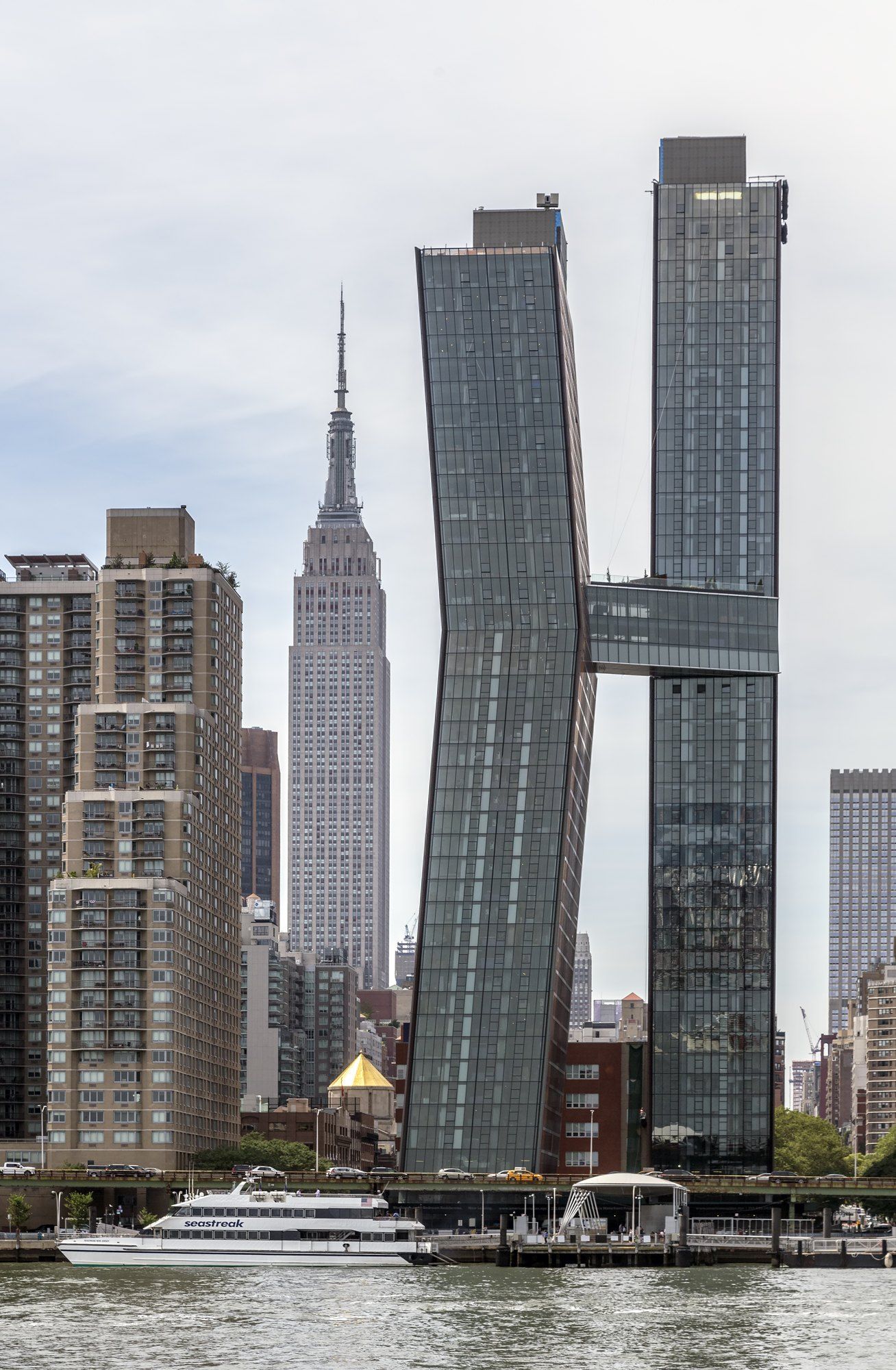
The Waterside blocks themselves, east of First Avenue from 38th to 41st Streets, stayed empty. In 2023 a light installation filled the lot, and in February 2024 CNN reported a proposal by Bjarke Ingels Group for hotels and apartments there, including a pair of hotel towers linked high up by a cantilevered span, on land the network said had seen little use for roughly two decades.7 The recorded history of the station notes that the plan, tied to a casino license bid, was rejected by the local advisory committee in September 2025.1
The site after the plant
- Plant demolished and ground cleaned
- 2008
- Rezoning of the former utility parcels approved
- 2008
- Former pier opened to the public as part of the greenway
- 2016
- Casino plan for the vacant blocks rejected by the local committee
- 2025
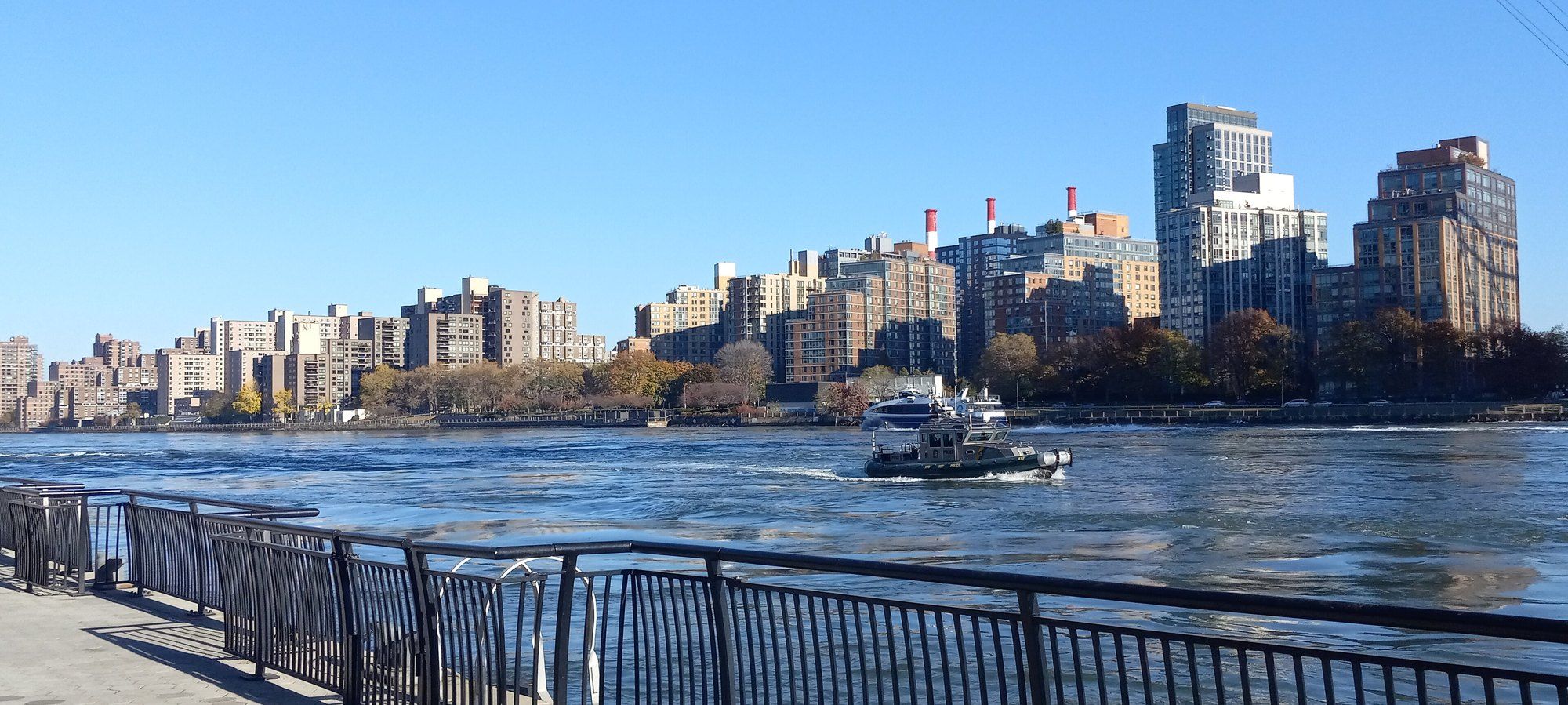
One piece of the old plant did find a new life. Its former pier on the river between 38th and 41st Streets opened to the public in October 2016 and now forms part of the East River Greenway.1 A walker on that pier stands where coal barges once tied up, looking back at four blocks that still carry no buildings, the plainest record on the East Side of how long it takes a site to move from one century’s use to the next.
References
- Wikipedia. Waterside Generating Station, read September 2026.
- Michael Minn. Waterside Generating Plant, 1999.
- Tudor City Confidential. New York Edison's Waterside Station, April 15, 2020.
- Power Engineering. East River Repowering Project: Design, Construction and Operation, August 1, 2007.
- Global Energy Monitor. East River power station, read September 2026.
- Museum of the City of New York. Construction of the 74th Street Power Station, June 12, 2012.
- CNN. Two Skyscrapers Joined By Daring Cantilevered Skybridge To Soar Over New York, February 2024.
- NYC Parks. East River Esplanade, read September 2026.
External links
See also
-
 The East River and Kips Bay
The East River Waterfront
Eighteen blocks of Manhattan riverbank on foot, from a park that began as a cement yard to a pier that once served a power plant.
-
 Building
The American Copper Buildings
Two bent towers in raw copper on the Manhattan shore of the East River, and the bridge that meets them where they lean closest.
-
 The East River and Kips Bay
The Ground Under the American Copper Buildings
Fill, rubble, coal smoke and a surge off the river: what the Manhattan shore east of First Avenue is made of, and how it behaves.
-
 The East River and Kips Bay
Skybridges in New York
Who strung rooms and passages across New York's streets and between its towers, and what each of them was after.